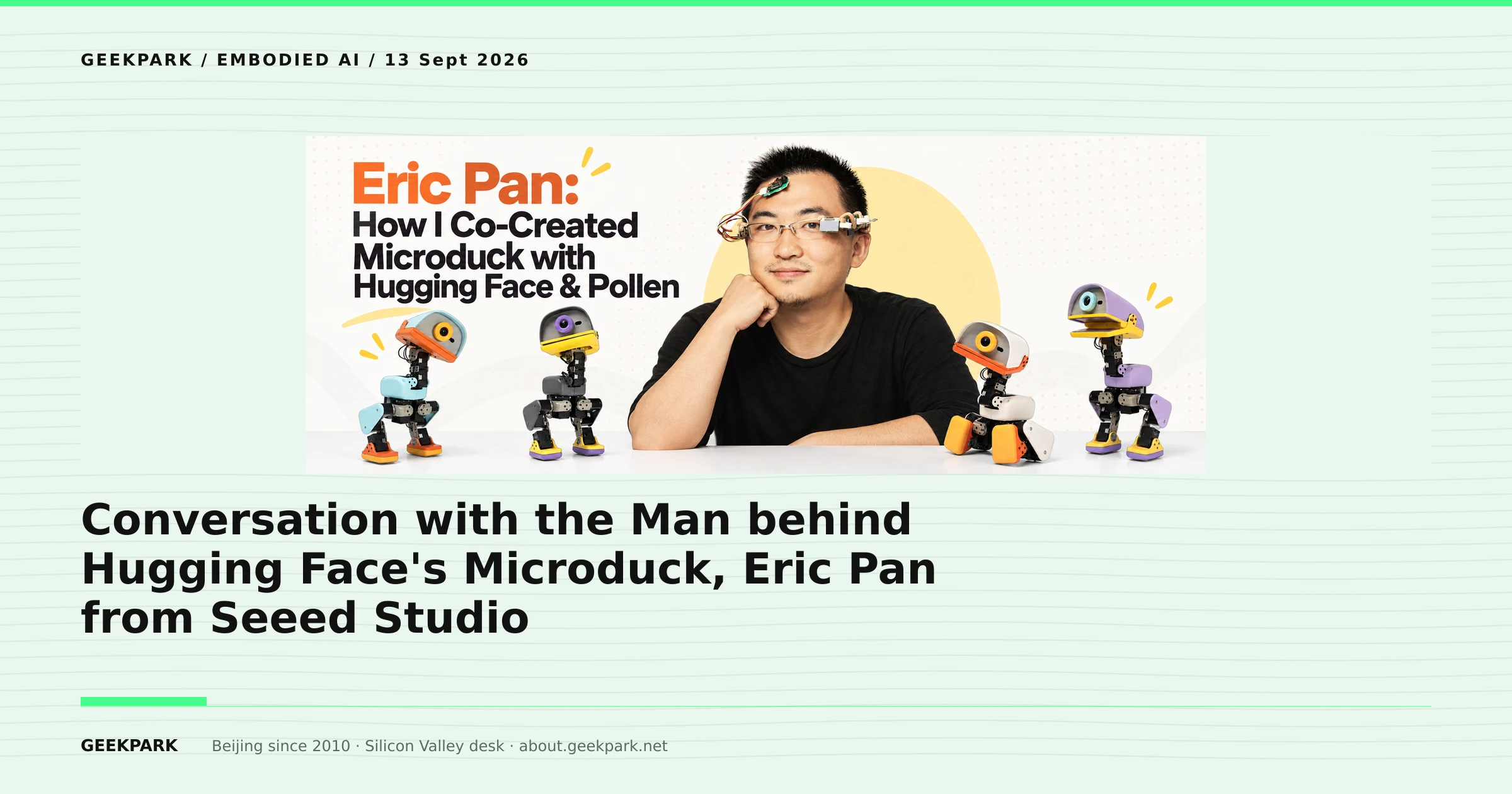
You've seen the duck.
Microduck — $399, from Hugging Face's Pollen Robotics — sold one unit every four seconds at peak. Ten thousand presold in five days. Over $5 million. Orders are booked into next year, and it left the tech bubble some time ago: your non-tech friends have seen the duck.
What you probably haven't seen is who builds it.
That would be Seeed Studio, in Shenzhen. Before Microduck, Seeed built Reachy Mini — the Hugging Face robot that reached NVIDIA's CES stage and sold out just as fast.

Left: the desktop robot Reachy Mini; right: the robotic duck Microduck. Both were developed by Pollen Robotics. | Image source: Pollen Robotics
Seeed's founder, Eric Pan, was a chipset product engineer at Intel. In 2008 he walked through Huaqiangbei, the electronics market that covers several blocks of central Shenzhen and supplies much of the world's hobbyist hardware, and decided not to leave.
He started Seeed Studio that year, sourcing and building for makers worldwide, and turned it into the junction between global makers and Chinese factories — part curated supply chain, part manufacturer.

Eric Pan, Founder & CEO, Seeed Studio
Eighteen years on, Seeed is one of the best-known open-source hardware manufacturers in the world. Ninety percent of its customers are outside China. It has sat somewhere in the supply chain of most Silicon Valley hardware waves you can name.
We started with one piece of business and ended somewhere broader: how the relationship between Bay Area founders and Shenzhen is changing, where a hardware founder's value now sits, and the rules of the Chinese supply chain that nobody puts in a deck.
One shift Pan has noticed: Silicon Valley teams arriving in China have moved from purchasing to something closer to handing over a child. He's also seeing more failures. His warning to software people entering AI hardware is direct — don't spend your energy rebuilding hardware from scratch. That's a form of respect. Your strength should be outside the hardware. Know what you don't have to build.
Edited for length and clarity.
By Lilyann and Zihua Su · Edited by Jingyu
Additional reporting by Liyuan and Sean, GeekPark (@GeekParkHQ)
01 · The part nobody can copy
GeekPark: Microduck is past ten thousand presales. Did that match your expectations?
Eric Pan: We expected the duck to do well. What we didn't expect was this — that it would break out this far, that everyone would love it, that people entirely outside tech would be paying attention. That caught us off guard.
GeekPark: Looking back, what part of it generalizes?
Eric Pan: A few things, and they run against how embodied AI is usually done.
First, it isn't a functional object. It isn't trying to prove a technology or hit a performance number. The creator is more like Geppetto — he set out to make something interesting, something like his own child, something he loved and put feeling into. That changes the product definition and the form. Bring a humanoid home and you might catch sight of it at night on the way to the bathroom and get a fright. It's too invasive.
A duck feels like a pet. Compared with most machinery it has more spirit in it. Watch the way it moves. We all know it's a pile of servos and a controller, but it moves like a small creature. A silicon-based creature. That's the first thing, and it makes far more people willing to accept it and look closer.
Second, it costs a fraction of a normal embodied robot. A humanoid might be hundreds or thousands dollars. A duck is 399 USD. People realize that for a price they can accept, they can own this very cute thing. That turns them from spectators into participants.
Those are the two key points. The logic they share: I buy a robot, I train it. It used to be a group of academics gathered around one or two machines. Now one person can have a pile of robots to train. The whole sim-to-real cost came down. We build larger robots ourselves, and when we take them to a show or handle them, we worry about safety and about load.
A little duck is harmless. It lowers the cost of taking part in training and the cost of reproducing results. The inner ring — researchers — see the duck and become its distributors. Then the next ring. Then the consumer ring, and everyone wants one. It's a smooth process.
GeekPark: So the first audience was researchers.
Eric Pan: Definitely. Look at how it launched — there wasn't much media coordination. It went up on Hugging Face's own site, and the people who follow Hugging Face are researchers and people working on large models.
GeekPark: $399 is far below other research robots. But there's real engineering in this duck — fifteen motors, a camera, a lidar. How did you get the price down that far? Where did the cost come out?
Eric Pan: There are a few paradigm differences from traditional robots. With many humanoid robots, the first sale usually goes into research, and research procurement is low-frequency. That's high-cost procurement — it needs tendering, and the transaction cost is high.
The duck is D2C, straight to the user, without much of a distributor layer. The pricing was set aggressively. There isn't much margin in this duck — when people try to clone it or hand-build one, their cost comes out well above its retail price. How do we do it? Overall optimization, including using this volume to negotiate upstream, and then a lot of engineering method in between.
GeekPark: What was the sequence behind the Hugging Face partnership? Did Hugging Face acquire Pollen Robotics first, or had Pollen already found you?
Eric Pan: Hugging Face acquired Pollen a few years ago. Our work with Hugging Face came after that — that's when they had more resources and more appetite for open-source embodied robots. That's the starting point. But our relationship with Pollen goes back much further, because they were already our customer. They were using our open-source hardware in their early development, so they knew us long before.
GeekPark: When Hugging Face came to you, was it already a duck?
Eric Pan: It was a duck when it arrived.
GeekPark: And on the rest of the details, was there a natural consensus?
Eric Pan: Largely, yes, because they know our boundaries and our capabilities, and we respect their thinking. It was a smooth fit.
GeekPark: What do "boundaries and capabilities" mean when you work with a customer?
Eric Pan: When we co-create with a customer — overseas or not — the customer focuses on their design, their knowhow, their software. What we want is for them not to just hand us a drawing. We want our customer to be a maker too, someone who can hand-build their own prototype.
They're like a painter. If the brush isn't in your hand, what you can create is limited. With all this open-source material available, you develop a form, 3D print a shell, and through that process you keep feeling your way and revising. At some point you show it to us, and once we can see you've proven these things out and thought them through, our communication cost drops sharply.
I know your intent. You're not handing me a parameter — I take your intent, add our professional judgment, and help you revise it together. That process is ideal and efficient, which is why we've turned down many people who came to us holding only an idea.
But plenty of customers arrive with a prototype, and often that prototype already uses our open-source hardware, which means it's already compatible with our supply chain. They built it out of my building blocks, and my blocks are already in the warehouse. So we're the best and fastest partner to scale it up.
GeekPark: How many suppliers did you connect for Microduck? Was this a set of requirements Hugging Face couldn't have handled directly?
Eric Pan: Going through us was probably a good deal more efficient. Take buying a single cable — who do you buy it from? Cables don't have a clear standard or brand. Do you go to a big supplier or a small one? Your requirements, safety compliance, all of it takes a long negotiation. And that's one cable. Do you want your energy going into that cable, or into product structure, community, core algorithms?
We've bought that cable maybe a thousand times. We're a curated supply chain for robotics — not an especially wide path, but a proven one. Come through us and it will at least work.
Your focus, your value creation, shouldn't be in the supply chain. It should be outside it. We joke that Chinese teams are good at making things cheap and American teams are good at selling things expensive, so American teams should stop spending every day trying to make things cheap.
GeekPark: Microduck's form isn't a phone or a tablet with a mature, process-driven line. The moment a novel form is involved, it gets hard to find a factory that understands what you need.
Eric Pan: And behind it isn't one factory. It's a factory inside a factory inside a factory inside a factory. If I need a cable today, upstream of that cable is plastic, is copper foil, is a production process. It's like a tree.
Everyone talks about the work, about how to do it. From where we sit it's a question of relationships, trust and confidence. Does each link in the chain trust its upstream and downstream? Do the upstream and downstream have confidence this product has potential? Transmitting that information is hard. Before wearables took off, how would a plastics factory have understood the category at all?
GeekPark: Where does Shenzhen's advantage show up?
Eric Pan: Chinese factories have no weak side. Cost, quality, innovation, initiative, sense of responsibility — and they're extremely elastic. The factory here is a larger proposition about engineers and supply chain collaborating. You can move the workers to Vietnam and Chinese engineers can fly over to support it, but that's a surface-level relocation.
Especially for innovative products. If you're a chef, you want to source at a seafood market, not walk along a shoreline picking up random ingredients. The efficiency isn't comparable. Look at the range of China's industrial categories. Say you want to build a robot — robots are complex.
There's electronics, structure, actuation, thermals, optics, acoustics, then packaging, materials, textures. Anywhere you do this, once you expand the form, it isn't just many parts. It's many categories of part. And if one material is missing today, the line stops. It isn't only whether it exists — the capacity has to match yours, and match it precisely.
"If a factory serves only you and leaves its other 90% of capacity idle, the price it gives you might be ten times higher."
Eric Pan: If capacity falls short — you need 100,000 units and the factory can give you 10,000 — the other 90,000 wait. But if a factory serves only you and leaves its other 90% of capacity idle, the price it gives you might be ten times higher. So it's a network, and after all these years it's become a rich, balanced, robust ecosystem.
An American coming to China is plugging into that network, fitting into its support and its gaps. If you want Made in USA, you have to rebuild that ecosystem from scratch. Both are legitimate and both exist, but for most founders, plugging into an existing ecosystem is much faster and much better value.
GeekPark: So it's a floor-level constraint. If one thing doesn't arrive, everything waits.
Eric Pan: If you're building something new, the fastest path is to enter the existing system.
GeekPark: So the relationship between a supplier and a customer, especially early, is more fragile than we imagine.
Eric Pan: Yes. And it's fragile in another way, a reasonable one. You agree with a supplier to build this thing, and one day the supplier tells you they've taken a big order from an important customer and can't serve you anymore, or their lead time has stretched. You can't stop someone else from making money. And this doesn't happen once. It can happen at every link in your BOM. If you're sitting in San Francisco, unfamiliar with all of these suppliers, how do you handle it?
Take Pebble Watch, an early representative of smartwatches. They raised more than ten million dollars on Kickstarter. The founder, Eric Migicovsky, has said that to build the first-generation prototype, he and three members of his hardware team spent roughly six months living near the factory in Shenzhen.
He'd raised more than ten million dollars, he had hard demand, he'd proven the category, and when he talked to suppliers everyone knew the volume was large enough and that investors and major players were involved — and there were still that many problems.

Pebble Watch2 | Image source: Phone Arena
He'd sold ten or twenty thousand watches by then. What about a brand with a smaller number? When they took an order for twenty thousand watches to the watch factories, many would have seen it as a small order. And that's before you get to a smart watch, where I'd have to cut a dedicated mold for you. That's an enormous gap.
GeekPark: How can we help founders? Would it help if teams used more open-source hardware?
Eric Pan: Yes. On method, we try to tell customers things in advance. We produced an Open Manufacturer white paper — when someone comes to China we send it first. Read it, or have your agent read it, and based on your product there may be things you should watch for, problems you didn't know you should be thinking about. Think about them first.
Second, base yourself on open source where you can. Your product doesn't have to be open source, but if you build on reasonably popular open-source hardware you'll avoid many detours — in design, in quality, in delivery, in supply chain.
02 · The hotpot test
GeekPark: If a founder from outside comes to Shenzhen and goes straight to a factory instead of working through someone like Seeed, what detours do they hit?
Eric Pan: The most immediate one is that most factories won't want to deal with them. A factory's thinking is: the bigger the volume the better, the bigger the counterparty the better. If you're Apple, you hand over a card and everyone is instantly circling you. The factory asks who you are, how big your company is.
The answer is: two people. In practice it's usually a little better — the factory is willing to cooperate at first, and then as the work goes on, why can you never get this thing finished, and the trust that had been building collapses.
Both sides are running a trust-matching mechanism. Big factories won't engage with you; small factories don't have mature enough experience. And on the founder's side, your product, your state, the stage you're at — none of it is set up so that you ask for a brick and get a brick to a national standard. That isn't what this is.
It takes both sides investing and committing, and in between you need a mechanism for building trust. What we do is bridge the two ends. We work with small and large factories alike, because we aggregate fragmented demand, strip out the common part and buy it centrally.
When I raise a requirement, I raise it professionally. When I place an order, I come with a professional guarantee — you don't need to worry about getting paid.
But not every product is suited to going through us. Some of you have raised a lot of money and are happy to go direct, or you have an experienced program manager. There are many paths. We're only one of them.
GeekPark: Has this collaboration model become an established convention between Shenzhen and Silicon Valley, or is it still being figured out?
Eric Pan: For us it's a mature model. For Silicon Valley plus Shenzhen as a whole I wouldn't dare say, because our view is limited and biased.
The most natural Silicon Valley attitude is: I've just raised a lot of money, I need to find somewhere to manufacture. People have tried Singapore, Malaysia, India, some inside the US. And then they find the teams that win and take the market are still the ones working closely with China. That's the end result.
Once that result exists, two things can happen. One is Chinese founders going to the US, building a company with a Chinese core and taking the market — Anker and companies like it, going outward.
The other is Silicon Valley teams hiring Chinese people and building much stronger linkage with Shenzhen. Because it isn't a simple buy-sell relationship. It isn't coming to China to source a part, verifying the quality standard, and being done.
It's much closer to tuōgū — a Chinese term for entrusting your child to a guardian before you die. You're handing over your child, or your pet, to a partner you trust, because this is being built from nothing and problems will come from every direction, and everyone has to solve them as a team.
In the previous wave, many teams came and left empty-handed, having spent a lot of money without getting the thing built. They hadn't respected our factory smart. A great deal of frontline manufacturing experience isn't written in books. A worker who looks perfectly ordinary may be the one who can guide you. Whether a highly paid Silicon Valley engineer arrives on the floor with an imperious attitude or an open, at minimum level-headed one — that affects the outcome.
GeekPark: Is it harder to raise now without hardware?
Eric Pan: In the Bay Area, I think so. If you're pure software it's now easy to have no moat and no differentiation — that's been ground down completely in the Bay. Add hardware and you can find new data, new deployment scenarios, a new experience. The complementarity is strong.
GeekPark: What kind of founder makes that attitude shift easily? And what kind can't adapt?
Eric Pan: We have one test: are they willing to eat hotpot with us. Whatever your background, being willing to eat hotpot with us means you're willing to accept an unfamiliar custom or food, or that you already understand something about the culture. You'll be facing all kinds of new ingredients. Do you resist, or are you willing to try?
We've had customers and partners who wouldn't try anything new in China, holding on to their bread. That person won't do this well. Their perception is bounded, and building trust with them is slow — and that slowness can be fatal. That's the simplest test.
Above that test, it inverts: we're trying to use the simplest possible instrument to work out whether a team will go humble. Are they willing to accept what they don't know and try to learn it? Which is the same principle as manufacturing and hardware.
It isn't a buy-sell relationship, it's a partnership. Like a long trek together, heavy packs, into a wilderness with nobody in it. Who do you pick to go with you?
GeekPark: You used the word tuōgū. Is the real relationship deeper than the partnership we imagine? Does most of the business end up being done by Shenzhen?
Eric Pan: It depends on the complexity of the product, or its maturity. If the product is mature and the form is immediately legible — it looks like a phone, you're making a tablet — then it's picking one supplier out of N. But if what you're building has no precedent, everyone has to take risks and run experiments together. That's the wilderness state, and it takes much more understanding and alignment.
Why were we willing to commit to a project like Hugging Face's? Because we could see the project had taste and quality, and that it was distinctive. As opposed to the many people who come to us saying, "I heard that product took off, I want to make a similar robot, how much would you charge." I generally turn those down.
GeekPark: What do you look for in the companies you work with?
Eric Pan: Take Hugging Face. That much influence, building a robot, using data as a flywheel and hardware as the carrier — that's logical. And talking to that team, they're pure makers, it's smooth, and the product is differentiated and inventive.
We look at many direct and indirect indicators beyond our own instinct. If a popular open-source project like Home Assistant comes to us, you know immediately it's worth doing. Or if someone has real influence and has already built a product a proven user base needs, that's easy to verify. But we don't necessarily pick the biggest — and the biggest don't necessarily come to us. We look for the products with more potential.
GeekPark: Why not the biggest?
Eric Pan: The biggest — Luxshare, say, one of Apple's main assemblers — will build a complete team and do it in-house. And much of that is pure consumer product, which also isn't our highest priority.
GeekPark: Why is pure consumer product not a priority?
Eric Pan: Pure consumer product has a lower probability of success and flames out easily. It usually needs its own aggressive team to pull off. We'd rather work on things that are less fashionable but meaningful and influential — exploration in vertical niches, exploration of new forms. That's more worth doing.
GeekPark: How do you decide internally whether something is a consumer product?
Eric Pan: The test for a consumer product is whether it exists to satisfy desire rather than to create value.
What we're good at is realizing a new technology and pushing it out. Our logic for new technology starts with researchers, then businesses, and only then consumers. We'd rather do the business work. The consumer work is already brutally crowded.
03 · What to do when you land
GeekPark: If a software-first team wants to build hardware capability and comes to Shenzhen for the first time, how should they spend a month?
Eric Pan: If you're not from the hardware world, don't spend your energy rebuilding hardware from scratch. That's a form of respect. What we're afraid of is a software engineer who hasn't done hardware — smart, capable — because some of these holes you have to fall into yourself.
So first, walk the boundary. Huaqiangbei, and Shenzhen Robot Valley. Both are worth seeing. The point is to know where the boundary of hardware currently sits. Whatever hardware you see already existing in Shenzhen, or simply already built, you can usually find an existing company to reproduce it or an upstream company to supply it.
After you've looked, get hands-on. Not building hardware — using hardware. Don't start from scratch. Build on what exists. Your strength should be outside the hardware; that's what makes you worth having in Shenzhen.
We're putting together courses on vibe coding a piece of hardware, vibe coding a robotic arm, and you find software has already come this far. We used to separate front end, back end, embedded, microcontroller-level embedded, then FPGA. Now vibe coding cuts through all of it — you can not know C and still control a small embedded device in Python or Rust.
Turn it around and hardware is one link for you. It takes a button that was on your screen and puts it in the physical world, where even a cat can trigger it. In using it, first you build confidence, and second you learn what's already available — which tells you what you don't have to build. If I had one phrase for what we do, it might be vibe hardware.
GeekPark: Seeed runs a maker space called Chaihuo. Are these courses part of it?
Eric Pan: Yes. The courses are open source and free. It's mostly about giving people a way to exchange with each other, and we encourage more people to take them, so a mutual trust mechanism can form. Our philosophy, the one thing that hasn't changed in more than a decade, is "making technology accessible."

Chaihuo Makerspace | Image source: Openthings
Chaihuo's role is before a company starts and in its earliest days. You haven't formed a team yet, so how do you see the range of possibilities, how do you talk to different people? Chaihuo is a starting point. There are events and workshops, and afterwards you may find that with everyone's help you can do it — like a one-person company that hasn't raised anything being able to bang out a prototype at Chaihuo.
Many overseas teams come and stay in that space, and prototyping there is more efficient, because they're not imagining components and buying them from far away. They can go directly to the supplier, to the factory — to design from manufacture. They can see how factories are already doing this, or find something in a similar form that's already proven and in mass production, and ask whether they can borrow and adapt it. The efficiency is much higher.
So the first step is to come to Shenzhen and look. Come for three days, or a week. Then come a second time and stay a month, living and working here alongside everyone, opening up your thinking, meeting people, making friends. Someone will be good at structure, someone else has already been through the electronics problems. Plug into the ecosystem here. Whether you then go back to the Bay Area to start your company or do something else, it'll be easier.
GeekPark: Among founders coming to Shenzhen recently, are there collective tendencies in what they pick?
Eric Pan: The ones that cluster too tightly — chasing whatever just took off — we generally invite to figure it out on their own.
04 · Hardware's value is outside the hardware
GeekPark: Humanoids or small desktop robots like Microduck — which is the easier path to volume?
Eric Pan: This one is simple: the cheaper it is, the easier it ships. In pure numbers, the lower the barrier, the more people take part. That's one factor. The other is the WHY. Many founders in Shenzhen focus too much on the HOW and neglect the WHY.
With a humanoid — what's my reason for buying? I bring home a two-hundred-thousand-yuan humanoid, and then what? Have it fold my clothes? An ordinary person can't make that add up. I can't convince my mother to spend two hundred thousand on a robot to fold her clothes, so who can you convince? Whose problem is that two-hundred-thousand barrier solving? And what problem does a two-thousand-yuan duck solve?
Quite a few. As a high-end figurine, as a toy, as a pet — it's comparable spending. The core is still embodied AI training, of course; other users can then try it as a robot pet they can train. As for other embodied robots, we care about applications. We've been waiting the whole time for one thing: what job can this robot do today?
Take Reachy Mini. The most direct use is service and retail. I put one at a front desk — at minimum it gives my customers a better impression, and for one or two thousand yuan it's a productivity tool if it can queue people, talk to a customer, take a number. Same with robotic arms. An arm used to be a hundred thousand yuan, now it's ten thousand, and at a few thousand it can do a specific job. That's much easier to scale.
GeekPark: What's the key to Microduck still existing in a few years without being copied out of existence?
Eric Pan: The key is that it isn't just hardware. It's already a cultural phenomenon.
And even if it weren't — under the original plan it's a carrier for embodied data. Everyone trains on this pile of things, and because there are so many models on top of it, everyone stays willing to keep using the duck.
GeekPark: So the duck effectively becomes data.
Eric Pan: Right. Which comes back to the point I keep making: hardware's value is outside the hardware.
GeekPark: The duck's software is open source, but the hardware isn't yet, correct?
Eric Pan: Correct, the hardware isn't open source for now. So I don't think this is necessarily the endgame either.
GeekPark: So the ideal endgame is that you build an innovative product, and that product becomes a building block, so the people who come after can assemble better models out of more and more blocks?
Eric Pan: That's our model, though for Pollen or other companies it might not be. The common thread is: don't treat hardware and shipment volume as the only answer.
GeekPark: On the software side people explored a lot — building on things like OpenClaw — and the coding track broke out first. Does hardware end up similar? Everyone has a passion project they want to hand-build, but what scales is still functional?
Eric Pan: They combine — functional hardware plus applications and presentation that have real expression in them. The functional part is already mature. A duck: the main controller is a single-board computer, the legs are servos, the microphone and speaker are already modular. This is integrating them into a new form. It's a combination of functions, high cohesion and low coupling as an engineering matter.
But each person can point it at a different WHY, and the WHY each person defines is where the value and the appeal will be.
05 · Too many shells, not enough ghosts
GeekPark: Since embodied AI got hot, have the people coming to Shenzhen changed? In number, in what they want, in their role?
Eric Pan: It isn't necessarily about embodied AI. It's that after China and the US both tried everything, people found the only place to come is still Shenzhen.
The wave coming now is related to embodied AI, because they were passively migrated here by the large-model track. Some were doing software, then got laid off, or left of their own accord, and needed a new frontier, a new border zone — and software plus hardware is embodied AI. Whether it's a robot, or a robot shaped like a human, isn't fixed, because a robot is a form and a carrier, a configuration of hardware.
How a robot ultimately solves a problem will come from combining with the knowhow of some industry. Say I'm a chef, or a psychologist researching elder care, or a hotel group. At a certain point robots get pulled in by the industry, in reverse. The cost sits in the robot hardware, but the return sits in the industry knowhow.
GeekPark: Comparing two years ago to now, has embodied AI risen noticeably as a share of your orders?
Eric Pan: We don't separate out embodied AI, because at this point everything we make counts as embodied AI. Take the sensors we've built for years. Sensor data used to be collected and then judged, or processed by a person. Now that data goes straight to a large model and becomes a derivative of the model. I don't know whether that counts as embodied AI, but we count it.
We now split our product lines into two halves. The first is Everything to AI — more real-world data is needed. Even the camera on a Reachy Mini is real-world data, and its conversation is corpus.
The second is AI to everything: making AI small, cheap and usable. There's the large end, hundreds or thousands of TOPS of compute, and the small end, an embedded model running on a 30-milliwatt, five-dollar microcontroller. Once these models are built, they can be pushed into existing devices and fixtures and objects.
So everything in our range from here is tied to AI and embodied AI. It's only that our definition of embodied may be broader than most people's.
GeekPark: I think our definitions are the same. I just didn't expect your whole product line to be AI-related now.
Eric Pan: Probably because we don't make things that are only for people to use. We don't do consumer product. In B2B there's a clear trend from human-to-human interfaces, to human-machine interfaces, to agent-to-agent.
For agent-to-agent you take what exists — say a dashboard and a bank of buttons — and use something, an AI camera or a machine finger, to operate it and connect it into a system. We encourage users to open up that thinking. Embodied AI doesn't have to be a humanoid. If we go back to the core definition of a robot, it never said it had to be human-shaped. If I'm a microwave today and I talk with you and can identify what's inside me, I'm a robot too.
GeekPark: Back in 2023 Seeed said it was betting on AI. What did that mean concretely?
Eric Pan: In 2023 large models weren't yet mainstream, and what I was doing was edge-side AI — putting reinforcement learning and classification algorithms into small edge devices.
Where you used to need a server behind a camera, now for a dozen dollars inside the camera you can run a classification algorithm. When large models arrived we went immediately to heterogeneous edge compute. Say you want to use a large model on a camera — that burns a lot of tokens, because it has to read every second. Put a small embedded AI in front, and I only pass the key frames I've identified to the large model. That saves a lot of cost.
GeekPark: So in product terms, more edge computing devices?
Eric Pan: Yes. More compute on one hand, and on the other the data path — MLOps — building out the whole chain from training to deployment. Above that is large-model integration. For example, we use a 4.5B model, and dropped into a specific scenario it can do plenty. I go to a restaurant to order. There's a button on the table, I press it and talk to it. I don't need to discuss the weather with it. I only need it to match and filter the dishes this restaurant has. How big does that model need to be? It can be small.
So in B2B, the opportunity and the room are limitless.
GeekPark: How do you come up with these scenarios? Do B2B customers bring you demand, or do you do your own advance research?
Eric Pan: Both, and it's a loop. Interesting attempts emerge in the community, some take off, people understand what's behind it, and then it turns into something more productized that inspires more people.
We rarely do big product planning. We curate the newest technology in, users run PMF experiments, and what comes out isn't necessarily a serious or large-scale product — but it feeds back to us, or to them, and they influence each other, and eventually one product gets selected out and becomes a hit. This duck wasn't the first duck we tried, either.
GeekPark: Over the past year and a half, AI toys and AI hardware have been hot, but the ones that broke out almost all came from open-source hardware — XiaoZhi AI, Reachy Mini, now this duck. Why?
Eric Pan: It's a logical necessity, because the mass market always lags. It's always a step behind. It gets led there by pilots and early adopters, who are themselves makers and hackers, and they're the first to encounter open-source things.
With something closed, I can see it but I can't touch it. With something open, I become part of it, I can use it early, believe in it, contribute to it, and not worry about being expropriated. So hackers, makers and geeks naturally gather around open-source projects. Meanwhile the large companies have the ability to lead consumers but usually don't dare to innovate. Look at Apple — as strong as it is, it doesn't innovate much now.
An open-source project doesn't have that much earning power, but it can unite the geeks. And when the thing has real value and the friction is low enough, it breaks out.
GeekPark: We've also seen founders building businesses in open-source hardware — M5Stack took off, and now new teams are building similar desktop robots for the maker community. Is that market really that big?
Eric Pan: The maker market is growing fast. When we started in 2008, you had to spend a long time explaining what a maker was. Now you don't have to explain what a maker or open-source hardware is, or why anyone would open source.
Ten-odd years ago most people had never seen a 3D printer. Now plenty of households have one, and you can define anyone who owns and uses a 3D printer as a maker. That's a large number of people, and it's expanding.
Consumers are also changing now that they have AI. Many people never had the opportunity before, but now I can vibe code my way into being a programmer — it's hard to say that person isn't a developer. And from there to maker is a short step. I already have web coding; I want to put my web coding into a device. There's a lot of room in that.
GeekPark: Will open-source hardware become increasingly consumer-grade? Electronic Lego, barrier dropping — does it become consumer electronics?
Eric Pan: The underlying logic is like personal websites, or indie apps. Everyone can make one, and because everyone can, many unserious things appear, or things I made purely to delight myself. Indie hardware becomes the indie game console.
I think we'll see more cyber accessories, more eyewear. Future electronics will be more like personal expression: I don't make much money, but I'm cool, I can make something different. It doesn't have to become a thing everyone buys at high volume. Before, you had to cut a mold, you had to do mass marketing. Now I post on RED, Xiaohongshu, with something 3D printed, and everyone can use it — if you like it, I give you the source and you copy it yourself.
GeekPark: Are the people motivated to build open-source hardware a particular kind of person? Pollen was acquired by Hugging Face, which gives it more incentive. For an ordinary maker, where does the drive come from?
Eric Pan: The main driver is still interest and passion. It's like making short videos, or being a YouTuber, or a Bilibili creator. You're interested in a direction, you share, people get more interested, you keep investing, and it may even become a profession.
If video and news can be done by individuals, hardware built and released by individuals is the same. I made one product, it's interesting, and I only make a hundred sets — or I run a group buy of five hundred each time. Who says our mice all have to look the same?
GeekPark: Do you see a clear trend rising, in China and abroad?
Eric Pan: More and more of it in both. Search Taobao for strange keyboards, or e-paper things. Take the little yellow duck — if you can't buy one today, fine, people start hand-building, and there's a nationwide wave of hand-built ducks. Then after the first pass, well, you have a duck, I don't want a duck, I want a goose, or I have my own IP character, and I start creating.
And why is that person good at creating? Because they studied sculpture, or they were a designer of anime props. Interest is the core of it, not some grand but hollow trend.
GeekPark: Seeed also develops its own hardware. What do you build in-house and what do you buy?
Eric Pan: We don't develop components in-house. If we need a chip or a camera, we integrate the mature option — but we turn it into a module so users can use it easily. Over the past few years we found that users building things out of modules was also unreliable.
Say I want to build something for outdoors and I haven't considered any of that, and afterwards it's hard to change. So we started building open-source devices — as if I've already made it into a box, and you also want a box, so tell me how you want this box changed. Leave the thermal part alone, we've validated it and it needs no new mold, but swap the interface, change the logo, add something. We turn our devices into the user's reference design, then into a solution, with hardware and software already done, that you can customize.
We're building out in both directions so a user's team can be smaller. They don't need a specialist optical or thermal engineer. They need our open-source hardware plus an idea, their algorithm, their market influence, and they can work with us lightly.
It's like software — from doing everything yourself, to IaaS, to PaaS, to SaaS. We're Manufacture as a Service. But the starting point is that you still have to develop on top of our framework.
GeekPark: Is it a shame that you're always working on the frontier, on developer-facing products, and once something matures it moves into a much bigger mass market that may not be yours? Have you considered taking the mass market too?
Eric Pan: Those are two questions. First, once a market gets big, is it still our market? Every company has a range in which it's alive. We built this business around the tech and maker community, so not being able to serve consumers is normal. Or if some enterprise vertical takes off and we don't understand that market, we shouldn't be taking that profit either.
Second, us not taking that market doesn't mean our customers don't take it. My job is to help our customers win it. We're happy to work with small teams to go up against big opponents.
Now that Microduck is out, plenty of competitors will imitate it. Three years from now, when we talk again, Microduck shouldn't have been killed off — it should have played an important role in the process. It shouldn't be that we showed up early to the market and then got wiped out. I don't think it goes that way. Every industry should be like this: helping our users succeed in each industry is enough.
GeekPark: Do you plan to bring Seeed to the front of the stage rather than staying a partner?
Eric Pan: We're the stage, but I don't have to be the actor. We're not hiding behind it either — here we are today, talking about what happens on stage and behind it. But we can't take the actor's job, because the actor has their own audience.
Beyond that, the stage is large and we'll take more opportunities. There's a lot of room in combining hardware and software, and OpenAI and Claude are both pushing toward physical AI. I think that moment arrives soon.
Here in Shenzhen, what troubles us is that there are too many shells without ghosts. The soul is underdeveloped and it's all very hard hardware. But hardware's own value is incomplete, insufficient. It has to be joined with meaningful software before it's a whole solution. And the further that is from Shenzhen, the more valuable it is.
Shenzhen is the rear base. Keep working to make the hammer better. But the nail is somewhere far away.
As I said, our main criterion for judging a partner isn't whether they have hardware expertise. The ability to do hardware well sits outside the hardware.
Editor’s Note: GeekPark is dedicated to telling China’s AI story to the world and fostering a two-way exchange between Silicon Valley and China’s technology ecosystem.
If you have an idea or story you’d like to share, get in touch with the GeekPark Silicon Valley team.