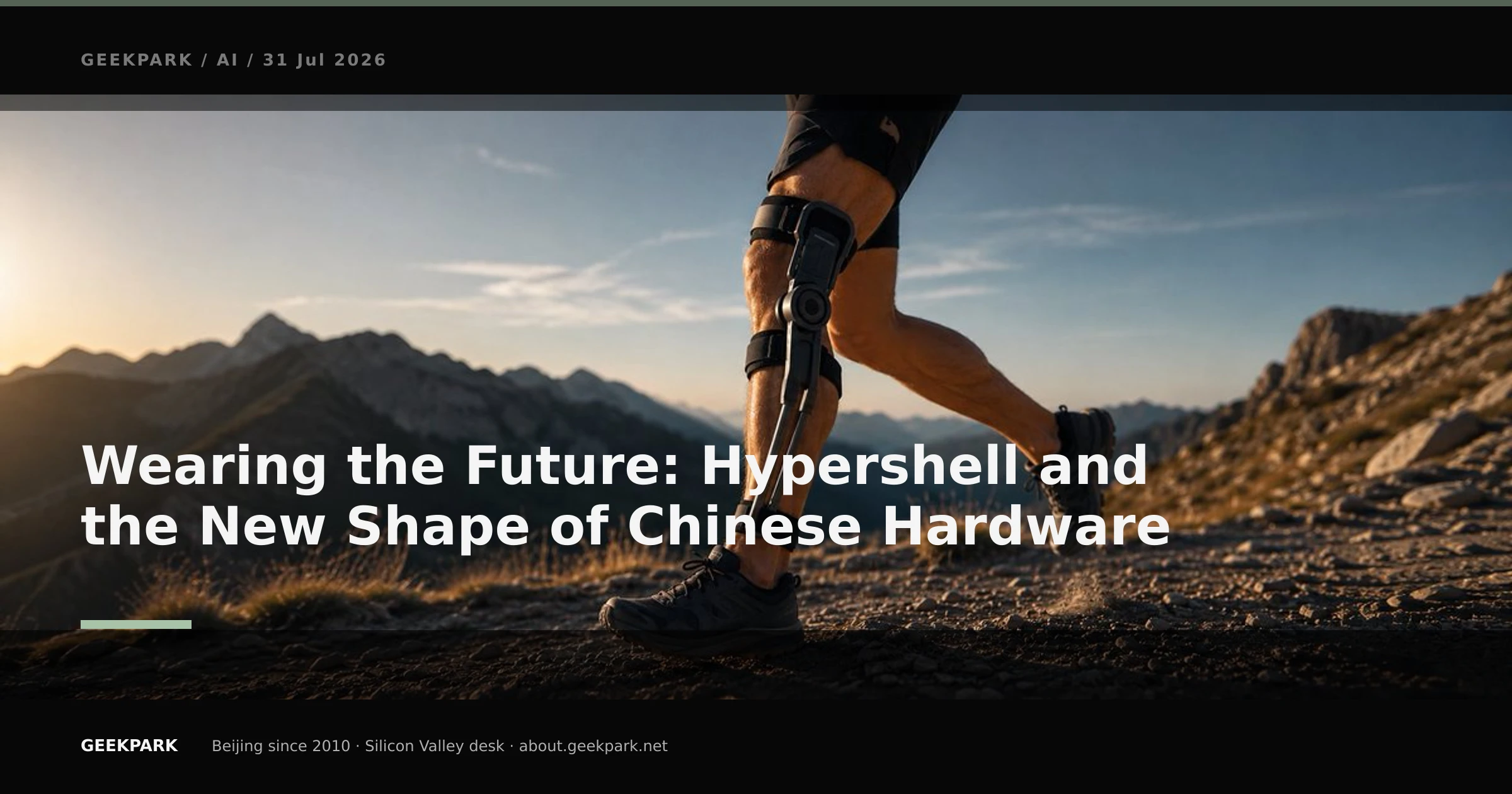
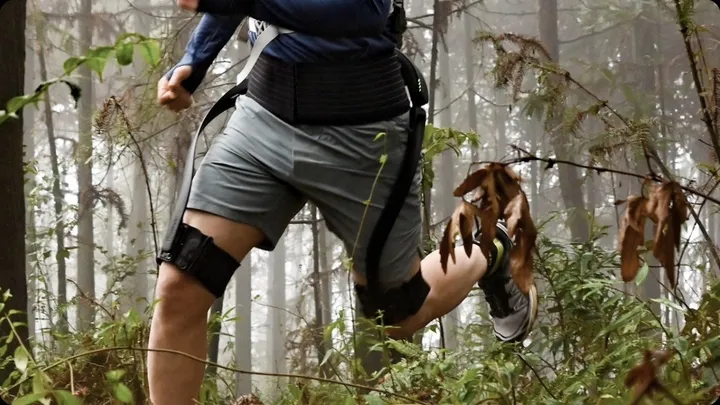
Walk into some popular mountain parks in China today and you'll see something that didn't exist three years ago: people renting exoskeletons at the base of the trail, the way they used to rent walking sticks. The device weighs about two kilograms, has one button, costs about the same as a decent pair of hiking boots to buy outright. Most of the people renting it have no idea who made it. @HypershellTech made it
And Sun Kuan, its founder, has a specific way of explaining why it exists: "Tools determine how large a person's imagination can be." He said this at @GeekParkHQ's Innovation Festival 2026 (GeekPark IF2026) last December, laying out his founding logic publicly for the first time. The product at the mountain park kiosk is the physical answer to that sentence.
The $120M across its Series B and the new X Series launch in May 2026 are milestones in a longer process. The more interesting question is what got the category here - and what this company reveals about a generation of Chinese hardware founders building in ways that look nothing like what came before.
What the product actually does now
The new X Series settles the question of whether consumer exoskeletons are a real product category. They are.
The flagship X Ultra S: 1000W peak motor output, 22 N·m torque, 30km range per charge, 97.5% gait synchronization across varied terrain, 0.31-second response time - 64.5% faster than the previous generation, TÜV Rheinland verified. Weight 2.5kg. One button.
That last detail is the output of HyperIntuition: Hypershell's self-developed end-to-end AI motion control system, and it signals a genuine architectural shift. Previous consumer exoskeletons ran on rule-based gait models: fixed patterns that couldn't adapt to uneven ground, stairs, or the variation between how different people actually move.
HyperIntuition learns. Instead of working in a separate sequence of steps, HyperIntuition works as one continuous system, processing raw data through the neural network, directly outputting the motor torque required for each joint.
It understands your movement as it happens and provides support instantly. Sun calls it the "external cerebellum" - the part of the system that handles automatic coordination so the conscious mind doesn't have to. "Just like the iPhone used the capacitive screen to achieve single-button interaction," he said at IF 2026, "AI (AI agent) lets the exoskeleton achieve the most simplified interaction threshold - users don't need to do anything other than turning it on and off."

Sun Kuan at the stage of IF2026
The 0.31-second response time and 97.5% synchronization aren't spec-sheet decoration. In a wearable system that assists physical movement, latency and synchronization have consequences in a way they don't in software. A chatbot that gives a bad answer is annoying. An exoskeleton that mistimes assistance on a staircase is a different kind of problem. Third-party verification on these numbers, and a 64.5% improvement over the prior generation, suggests real engineering progress rather than incremental polish.
Where it gets more complicated is the data layer. Every unit in the field generates gait data across terrain types, load conditions, and user profiles. The strategic logic is sound: that data trains better models, better models improve the product, which attracts more users, which generates more data. The problem is that "sound strategic logic" and "actual moat" are not the same thing.
Consumer wearable companies have tried this argument before - Peloton, Whoop, Oura - and found that sensor data was harder to defend than it appeared, because algorithmic improvements were replicable and the data wasn't as proprietary as it looked. The honest question isn't whether Hypershell should be building the data layer. It's whether data is the bottleneck, or whether architecture and model design matter more - and whether 20,000 units generates enough labeled, structured training data to make a meaningful difference.

(20,000 units at time of initial analysis; according to internal data, the number has since grown substantially.)
The SAR program is the more credible piece. 50+ search-and-rescue organizations testing devices in actual emergency deployments - sustained high-load climbing, irregular terrain, fatigue states - produces training data that no consumer dataset replicates and no lab can manufacture. Whether extreme-condition data generalizes to the average hiker is a real question, but the instinct to design field programs with data architecture in mind is sophisticated. Most hardware founders aren't thinking this way yet.
How the category got unlocked
The exoskeleton has been a near-future promise since the 1960s. Understanding why it failed for so long matters, because it explains exactly what Hypershell had to get right.

The hardware problem was fundamental: every additional kilogram of device weight increases human metabolic load by roughly 2%. A 10kg system costs you 20–30% before you've done anything useful. Old exoskeletons ran on fixed gait patterns that couldn't adapt to stairs or individual variation. "Locally effort-saving, but overall exhausting," as Sun put it at GeekPark IF 2026. A device that adds net burden isn't a mobility product. It's a constraint with a marketing budget.
Two things changed at roughly the same time. In 2019, MIT open-sourced quasi-direct-drive (QDD) motor research - power and torque densities exceeding human muscle by 10x at costs that don't require a defense contract. The second shift was AI: learned motion models replacing rigid gait programs. Sun's specific contribution was seeing something others missed. "I found an architecture that uses a single power system to simultaneously assist both legs," he said at GeekPark IF 2026. "At the time this was considered somewhat counterintuitive. But validated through simulation, it became our first-generation product - the world's first single-motor exoskeleton." That insight is what made consumer pricing possible. The M-One Ultra is its direct descendant.

He started the company in 2021, before most of the industry saw these doors opening. That's why nearly a hundred investors turned him down. It's also why the ones who eventually backed him made a good bet.
The decision that revealed the founder
In 2023, Hypershell raised $1.23M on Kickstarter - the first consumer-grade exoskeleton crowdfund, 40% of backers from the US. Then the grey-test scores came back. Nothing above 60 out of 100. Uncomfortable fit. Awkward assistance. Incompatible with backpacks.
Sun killed the product. Scrapped it, rebuilt with a new dual-motor architecture that doubled unit cost, took 18 months instead of 6, meant every second-generation unit shipped at a loss.
"If the experience isn't good enough, from the user's perspective, there is no experience at all."
This matters more than most founding decisions get credit for. The easier path was obvious and available - ship it, collect the cash, iterate later. He didn't take it. Hardware founders who optimize for short-term shipping numbers build a different kind of company than founders who kill their own product when the experience isn't right. The decisions that come later - when to cut a feature, when to delay a launch, when to spend on the right component instead of the cheaper one - tend to follow the same pattern as the first hard decision.

The second generation worked. Tens of thousands units shipped. Top-selling on Amazon in the US and Europe, and JD.com in China. Someone ran a marathon in it and swapped the battery mid-stride. Firefighters in Hong Kong climbed thirty-plus floors post-blaze while preserving enough physical reserve to perform rescue work - the first documented deployment of powered exoskeletons at scale in emergency response.
The competitive landscape
The most important thing to understand about Hypershell's competitive position is that it's not actually competing with the companies most people would name - and the reason goes back to a deliberate choice Sun made at the start.
The obvious first market for a mobility-assistance device is elderly care. Sun didn't go there. Before Hypershell, "exoskeleton" meant "medical aid" - a product you wear because your body is failing you.

A founding brand impression of medical equipment creates a permanently limited ceiling: you can grow the medical market, but you can never become something people want rather than something they need. So Hypershell went to the mountains first - hikers, backcountry skiers, photographers hauling heavy gear into terrain nobody else reaches - and built the category's first mental model around capability rather than accommodation. The downstream effect: elderly users who eventually bought the product posted about family hikes and returning to mountains they hadn't climbed in a decade, not about their mobility limitations. Same device. Different story.
That choice also defined who Hypershell is actually competing against.
Wandercraft is the most-cited comparison, and it's mostly a false one. The French company raised $75M in June 2025, has its Eve personal exoskeleton targeting the US market in 2026 - at $92,000, designed for individuals with severe mobility impairment. Its Atalante X rehabilitation system sells at $228,000 to hospitals. Wandercraft has sold 110 units total. This is a medtech company building toward FDA clearance and insurance reimbursement. It is not competing for the hiker who wants to see the view from a mountain peak. Ekso Bionics and SARCOS are in the same bucket.
The real competitive threat is closer to home: well-capitalized Chinese hardware imitators with the same Shenzhen manufacturing access and global distribution playbook. RoboCT raised $13.7M in March 2026. NAVEE showed up at CES 2026 with its Exo-Fit. Neither is dangerous today. But the pattern of Chinese hardware categories is consistent and worth taking seriously - drones, 3D printers, robot vacuums, e-bikes: once a category is validated, competition arrives fast and price compression follows. Hypershell's answer is HyperIntuition and the data corpus. Whether those hold when a well-funded imitator arrives with similar hardware in 18 months is the real durability question, and it's one the company needs to be thinking about now, not later.
The generation this company belongs to
DJI established the template that Hypershell is executing: neglected category, engineering depth over price, global-first validation, Shenzhen iteration speed. DJI didn't beat the drone market on price. It beat it because its flight stabilization was technically superior to everything else. The first generation of Chinese hardware exports won on cost. This generation wins on capability - and that's a fundamentally different, and more defensible, competitive position.
What's genuinely new about Hypershell's version of the playbook is the AI layer sitting on top of a hardware business. DJI's moat was manufacturing precision and proprietary flight software. Hypershell's potential moat is a motion data corpus that compounds with every unit shipped. The Kickstarter with 40% US backers before a dollar of retail spend is the global-validation move. The M-One Ultra from concept to production in under three years is the Shenzhen-speed move. The SAR program putting units into extreme conditions before retail scale is the brand play that doubles as real-world validation - stress-tested terrain and load profiles that controlled lab testing can't replicate. None of these are accidents, and the fact that they're all happening simultaneously at this stage of the company's development is a signal worth noting.
Sun's own read on the moment goes beyond Hypershell specifically. "We seem to be truly living in a science fiction era," he said at @GeekParkHQ IF 2026, "where things we could only imagine are accelerating into reality. Categories that people once thought impossible, or that existed but didn't have good enough experiences, can now be rethought and redesigned." What he's describing is a structural window - opened by AI and advanced manufacturing — where the gap between what's imaginable and what's buildable has collapsed faster than incumbents can respond. Hypershell got through that window early. The question is whether it can widen the gap before the window fills up.
The unit economics, roughly
The numbers that are public: tens of thousands units shipped, ASP probably around $1,000–1,200 blended across the SKU mix, gross margins 35–50%. That puts cumulative gross profit somewhere in the $7–12M range - real money, but not a business that justifies a $400M valuation on its own. Anyone who looks at those numbers and concludes this is currently a $400M company is confusing a bet on trajectory with a description of present reality.
Base case: 200,000 units at $1,500 ASP, 45% margins within 4–5 years → ~$135M annual gross profit. At 10–12x, that's a $1.3–1.6B business. Not a straight line from $400M entry, but within range if growth compounds and the software layer adds incremental margin.

The scenario that makes $400M look conservative: Ant and Meituan convert CVC positions into real distribution - exoskeleton rental in Alipay ticketing at scale, Meituan delivery worker augmentation contracts. That generates recurring revenue with entirely different margin characteristics. The standard CVC pattern is optionality without commitment, though. Whether this is one or the other is not answerable from the outside - and it's the most important question on the diligence list.
What comes next
Consumer exoskeletons are a rounding error in the overall market today - and the only segment growing at 3x the rate of the others. Hypershell has the entry point and the right brand architecture to expand from it. The outdoor positioning was always a first chapter. The Hong Kong rescue deployment, the HyperLIFT SAR program, the elderly users quietly reappearing in the user base - these are the category expanding outward from aspiration, the only direction a consumer hardware brand can expand from and maintain its pricing power.
The unresolved questions are serious. Can the data and software layer get built before the hardware gets commoditized by imitators? That window is probably two to three years, not five. Can a company whose DNA is Shenzhen manufacturing execution build the organizational capability for platform software - a skill set that has killed more than a few hardware companies that thought they could make the transition? Will the Ant and Meituan relationships have actual teeth?
Here's the honest read: the downside scenario. Hypershell remains a well-run hardware company that dominates consumer exoskeletons without ever building the platform layer - is still a good business. Probably a $1–2B business at scale, which at $400M entry is not an most neutral outcome. The upside scenario, where the data flywheel turns real and the CVC relationships convert, is something larger and harder to price.
What's not in question is whether there's a real company here. There's a real product, in a real category, built by someone who's already shown - on the record, at some cost to himself - that he'll make the right call when it's expensive. In hardware, that's rarer than it sounds. And it's the thing that all the financial modeling in the world can't manufacture.