In 2025, sixteen humanoid robots danced on China's Spring Festival Gala in front of more than a billion viewers. They were built by a company called Unitree Robotics. By the end of that year, Unitree had shipped more humanoid robots than anyone else on the planet - by unit count, at least. In March 2026, Unitree filed to go public at a valuation of 6.2 billion U.S. dollars. Eight years earlier, almost nobody had heard of Unitree, or of its 27-year-old founder Wang Xingxing. Same year, I issued a term sheet anyway. At that time, Chinese venture capital was busy chasing shared bikes, shared power banks, shared umbrellas. Robotics wasn't even a category. What follows is how that bet got made.
The WeChat Post I found Unitree through a short post on an obscure WeChat public account almost nobody had read. A few paragraphs, a couple of photos, a thirty-second clip of a quadruped called Laikago. Wang had named it after the Soviet space dog sent into orbit in 1957, the one that did not come back. It was the kind of detail that means nothing to a marketer and a great deal to anyone listening for it. I had a frame of reference. In 2015 I'd taken a delegation of Chinese founders to MIT, where one lab was running a hydraulic quadruped with a taxidermy cheetah head bolted to the front. The head was a little too large for the body, the body a little too tethered to its own cables to ever really run. The machine made the kind of noise that makes you take half a step back without thinking about it. Wang Xiaochuan — who would later found Sogou and then Baichuan AI — picked the cheetah head up for a photo. The mood in the room was that the technology might matter in a decade or two. 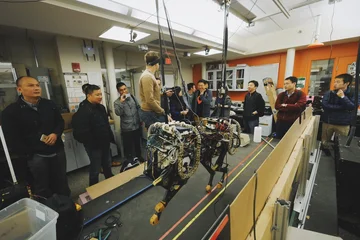 MIT Cheetah Lab, 2015
That was the global state of the art in 2015. Two years later, a team in Hangzhou I'd never heard of was showing a smaller, quieter electric quadruped in a thirty-second clip. What struck me was that, even in thirty seconds, it didn't look like a research project. It looked like a product. The proportions, the cable routing, the way it carried its own weight - all of it had the unmistakable shape of something headed toward a customer, not toward a conference paper. I booked a flight to Hangzhou within two or three days.
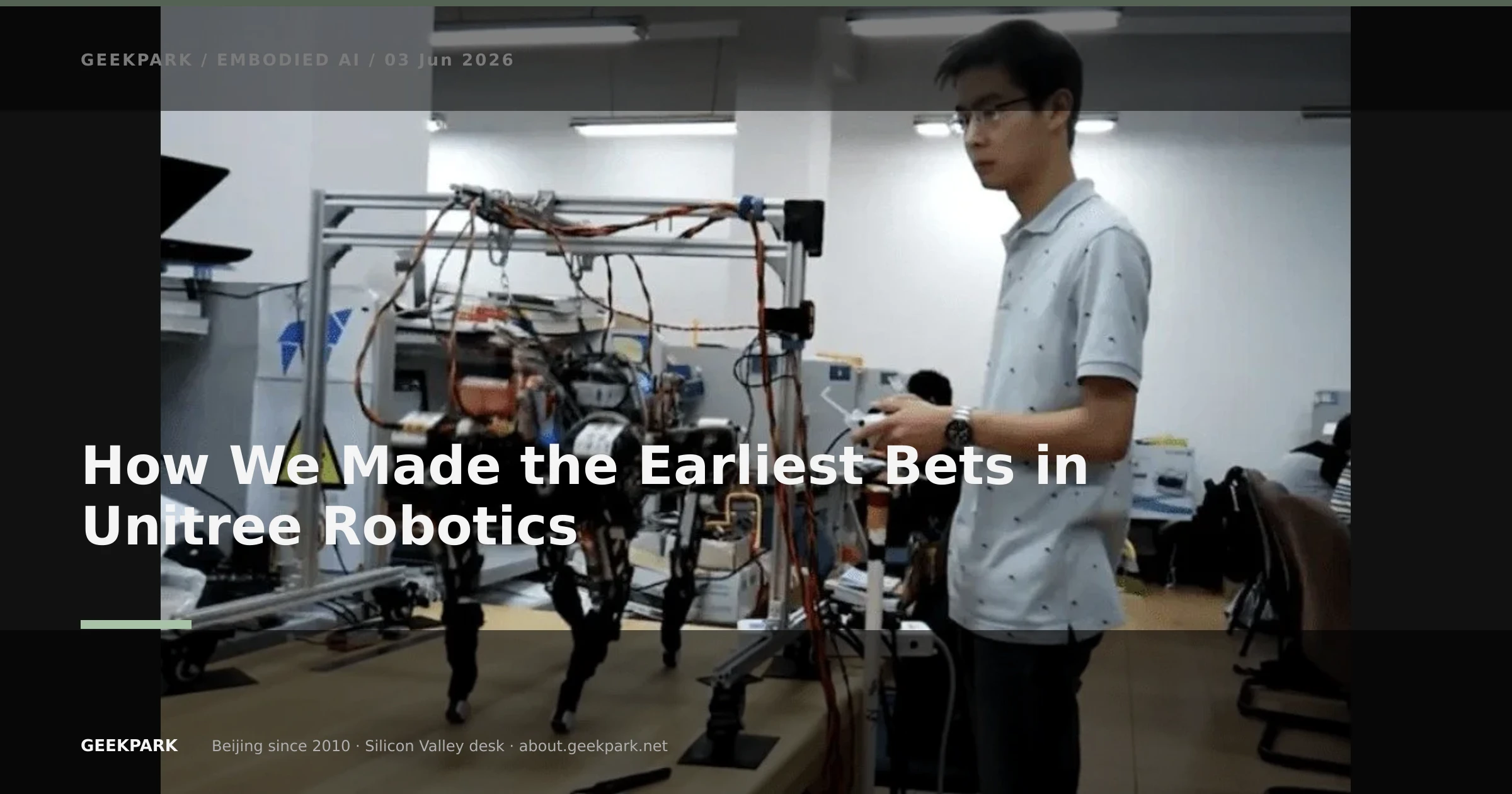
The Hallway Unitree's 2017 office was on the ground floor of a nondescript building in Binjiang, the kind of light-industrial district where the neighbors are sheet-metal shops and the address is more landmark than number. I couldn't find the door. When I did, I stepped into maybe twenty square meters with no desks, no meeting table, and no chairs. Parts stacked along the walls. Half-assembled frames on the floor. Two completed robot dogs in the corner. Wang Xingxing, then 27, looked like the graduate student he'd been not long before. He ran a brief demo: the dog walked, he shoved it with his foot, it caught itself. Then we stood there for a moment, because there was genuinely nowhere to sit. 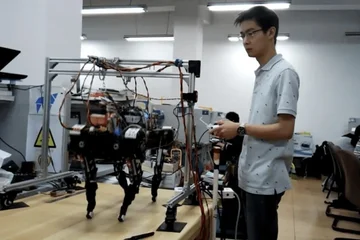 Xingxing with his XDog, during postgraduate period We ended up on a couch in the hallway outside the office - not even Unitree's couch. It had the orphaned look that hallway furniture in old commercial buildings gets, the cushions slumped at the edges, the kind of couch you don't sit on so much as land on. We talked there for nearly three hours. The conversation wasn't what I expected. The usual rhythm of a founder pitch is forward lean: market size, five-year plan, the date and the number for every problem. Xingxing did the inverse. I'd float a scenario - a home robot, a rural security guard, a wildlife deterrent - and he'd walk it back. There were specific engineering problems that came first. Behind those, more problems. The order wasn't negotiable. When I finally asked the most basic question in venture capital - what are people going to do with this - his answer was: build it first, and the research labs will buy it. That was the entire answer. There was no deck to speak of, just a few slides on the technical stack designed to bring an investor like me up to speed. No vision section. No total addressable market. No plan to dominate a category. He'd thought about the use cases considerably less than I had, and about the engineering considerably more than I ever would. I'd almost never met a founder who described his own timeline more conservatively than the investor across from him. The asymmetry was the thing. Xingxing knew the ground he was standing on with a precision that didn't match his résumé - no MIT, no decorated advisor, no co-founder from a famous lab. His undergraduate thesis had been on the design of a brushless DC motor controller; for his master's, he had built XDog - a quadruped - for under 20,000 RMB, designing the actuators, the control electronics, and the gait algorithms himself, around low-cost outer-rotor BLDC motors he selected and characterized. That was the part the rest of the field tended to outsource. Almost every "robotics" startup I had seen up to that point in China bought finished motors from Maxon or Faulhaber, wrote some control code on top, and called it a robot. Xingxing had built down to the actuator. He held the machine to a higher standard than it strictly required, because the distance between good enough and actually good was the part of the work that interested him. What was missing from his pitch was supplied by the object on the floor.
There was also the matter of the name - Laikago. 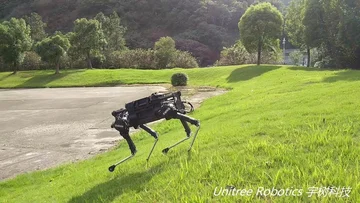 Laikago, 2017 I'd known the story of the Soviet space dog since I was a kid. Xingxing didn't strike me as someone who would name a product for marketing reasons - everything else about him was the standard engineering archetype, technical, undemonstrative, almost monosyllabic when the conversation wasn't about a circuit. But hidden under that surface was this small romantic gesture: a robot named after the first creature to ever orbit the Earth. I'd learn much later that as a child he'd been so bad at English that one of his teachers had told his mother he might be a little slow. A kid who couldn't pass an English test had built a robot from the motor up and named it after a Soviet space dog.
The Thesis I flew back to Beijing with a thesis. Inside Chinese venture capital in 2017, Boston Dynamics was the public benchmark - the company everyone invoked when they pictured what advanced robotics looked like. Inside the field, the real frontier was somewhere else. Sangbae Kim's Biomimetic Robotics Lab at MIT had been publishing the architectural answer for years: high-torque-density electric motors with single-stage planetary reductions, backdriveable, no force sensors, no series compliance, no hydraulics. The paradigm had a name - proprioceptive actuation -formalized in IEEE Transactions on Robotics in 2017, with MIT Cheetah 3 following at IROS 2018 and Mini Cheetah in 2019. This was the road I believed legged robotics needed to be on. None of this is to diminish Boston Dynamics. Their hydraulic Atlas did things - dynamic parkour, backflips, full-body manipulation under load - that nothing electric in 2017 could match, and a meaningful part of the field's understanding of dynamic locomotion was built on what they figured out the expensive way. 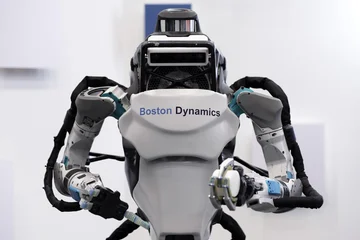 Boston Dynamics Shows Off Its Humanoid Robot That Can Run and Jump But the question I was asking as an investor wasn't who had built the most impressive demo. It was which architecture would scale to a commercial product at a price ordinary buyers could actually pay. On that question, hydraulics were a dead end, however magnificent. Electric drive was the direction the entire physical world was moving: it is far easier to make a fast, light, force-controlled electric actuator than a hydraulic one. Once you have one, the rest of the problem - balance, gait, contact - becomes a matter of control bandwidth and software, both of which were getting cheaper every year. Xingxing's XDog, finished in 2015, was built around low-cost outer-rotor BLDC motors with custom drivers - architecturally in the same family as what MIT was formalizing in parallel. He didn't invent the QDD paradigm, and he wouldn't claim to. What he did was something arguably harder in the Chinese context: he took a research architecture being developed at one of the most well-resourced robotics labs in the world and rebuilt a working version of it for under twenty thousand RMB. He has also said he'd concluded hydraulic actuation could not be commercialized as early as 2013, before any of the public pivots had been signaled. His view of where the field was going was identical to mine. The difference was that he had been building toward it for four years; I had been reading about it. The quadruped form factor wasn't a dead end but a foundation. The most important things a four-legged robot teaches you - how to design a torque-dense actuator module, how to manufacture it cheaply at small volumes, how to build the supplier relationships that keep the bill of materials moving - are the same things a humanoid will need, only harder. The dog wasn't a stepping stone in software alone. It was a stepping stone in hardware industrialization, and the hardware substrate was the part with the longest compounding curve. My working assumption was that the market for legged robots wouldn't open for three to five years. The question, then, wasn't whether but who: which founder could spend that time in the dark without losing the thread. That kind of road belongs to someone more interested in the dark stretch than the eventual payoff, whose head is full of the problems and not the pitch. The hallway had answered the question for me. What I'd later admit I hadn't yet understood was how important it was going to be that Xingxing refused to chase consumer markets at all. I'd spent most of the hallway nudging him toward exactly that - the home robot, the patrol guard, the wildlife scenario. He had walked each one back. I'd treated the consumer question as a discussion. He treated it as a no. The discipline turned out to be the founder's, not mine. We sent the term sheet in November 2017. At that moment, institutional capital in China was concentrated almost entirely in software, consumers, and shared-economy plays. A term sheet for a quadruped robot built by a 27-year-old with no deck, in a garage with no chairs, wasn't just contrarian; it was outside the category that contrarian bets were normally sorted into. I could afford to see it that way for a specific reason. I'd spent the previous decade meeting and tracking a generation of Chinese founders before the market had named them. By 2017, when GeekPark raised its first fund, every LP in it was a founder I had spent years with in their own early days. Also - which I'd articulate more clearly today than I could then - this specific company could probably only have been built in China. The architecture Xingxing was working with required small shops that could machine custom motor housings at low volume and low cost, electronics fabs that would run a hundred custom driver boards without making you feel like you were inconveniencing them, and a labor market where a competent robotics master's graduate cost a fifth of what the equivalent person cost in the Bay Area. It also required Chinese university and corporate research labs whose procurement cycles fit Unitree's price points almost perfectly. The bet wasn't just on a founder and a technology. It was, implicitly, on a place. I would not have written the same check for the same founder building the same robot in Palo Alto.
What I Couldn't Have Planned For Two things, in the year after we sent the term sheet: an afternoon I'd staged that didn't land the way I wanted, and a financing structure that fell apart. A few weeks after the term sheet, in early December 2017, GeekPark held its annual founders' tea on the side of the Wuzhen Internet Conference. Lei Jun of Xiaomi and Wang Xing of Meituan were there. Wang Xingxing didn't have credentials for the conference, which is why we deliberately picked a venue outside the main grounds. I wasn't expecting anyone to write a check. What I wanted was simpler: for Xingxing to be a name they'd remember, for these founders to have seen the machine and the person with their own eyes. 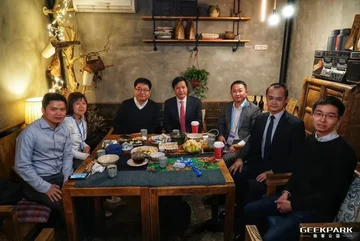 Around the table that day, from left to right, were: Chen Hua of Changba, Cindy Mi of VIPKID, Me, Lei Jun of Xiaomi, Zhou Yuan of Zhihu, Wang Xing of Meituan and XIngxing of Unitree. He showed up after the main conversation had wound down. He set the robot dog on the floor. The room turned toward it. It took a few steps, snagged a leg on the door threshold, and died - not dramatically, just the soft mechanical click of something giving up. He knelt down and restarted it. It walked a few more steps, but the air had already gone out of the moment. People were warm about it, genuinely encouraging in the way senior founders are to a younger one, and then everyone went home. A fun fact: Lei Jun had been Xingxing's idol since his teenage years, but Xingxing was too shy to even ask to add him on WeChat. But I still think it was worth getting him in the room, even with the robot face-planting on the threshold. You plant seeds. You don't usually get to watch them come up. A few years later, Lei Jun's fund came in at Unitree's Series A, and Meituan eventually became the largest external shareholder. Today, at Unitree's target IPO valuation, those stakes are worth roughly US$258 million and US$556 million accordingly. The second was the round itself. GeekPark's early-stage fund couldn't anchor it alone. Unitree needed between 15 and 20 million RMB, and the right structure required a larger lead investor - ideally one with hardware operating experience or a supply chain footprint. I spent the better part of the winter and spring trying to find that investor. A serious lead emerged, talks went deep enough to produce a second term sheet, then the deal collapsed for reasons that had nothing to do with Xingxing or Unitree. The shape of the problem was almost textbook: a founder I believed in, a thesis that hadn't changed, a signed term sheet from GeekPark, and no anchor behind it. The disciplined path was obvious - find a new lead and wait, or let the term sheet lapse and revisit when the structure could be repaired. Either move would protect us from carrying concentration risk a fund our size wasn't built to hold. Then Xingxing surfaced that Unitree's bank account was nearly empty and product shipments were at risk. He simply said he hoped we could move sooner rather than later. What he didn't say - what I learned from someone else - was that he'd already stopped paying himself and had been making payroll out of his personal savings. That detail didn't change the math. It made the math worse. But the math was no longer what was being decided. The question I kept circling was whether our actual judgment about the company had changed. The thesis was intact. Xingxing was the same founder he'd been on the hallway couch - more so, in fact, now that I could see how he behaved under pressure. The only thing that had moved was a deal structure. And a founder who covers his own payroll without informing his investors is not managing his investors - he's absorbing pain and asking for help plainly when he needs it. Years earlier, Zhang Tao - co-founder of Dianping, and one of GeekPark's first limited partners - had pushed me into starting the fund with a question I'd never quite resolved: You spotted Zhang Yiming early. You brought Elon Musk to China in 2014. What did you actually do for any of them beyond writing it up?
Elon Musk, at GeekPark's summit, 2014 Every dollar in our first fund came from founders who'd built their companies inside the GeekPark community before circling back to capitalize ours. Founders backing the next founder. We weren't a typical institutional VC. We weren't supposed to be one. So the question wasn't whether the deal made sense given the broken structure. The question was who we were. The discussion went around the same loop several times. At some point I stopped, sat with it a moment longer, recognized the thing I couldn't sit with, hit the table, and we wired the money. It wasn't, by any honest accounting, a clean piece of investment reasoning. In the second a decision like that gets made, it doesn't feel like an investment. It feels like the answer to a question someone asked you, years before, about who you were. 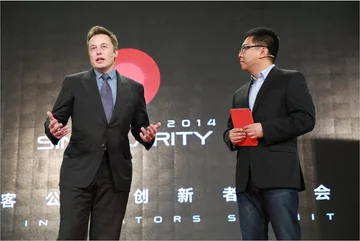 The Loop That Worked My confidence at the time had included an assumption that GeekPark would help raise the next round through our founder network. We never got to find out. Xingxing outpaced us by shipping product. By late 2018, Laikago was in the hands of paying customers - exactly the customers he'd named on the hallway couch: research laboratories and universities that needed capable hardware at a price a research grant could cover, machines open enough to be taken apart and built on. Scientists and engineers buying tools. The revenue was small but it was a loop: product, cash, better product, more cash. Xingxing was running the company without marketing spend, without influencers, without the apparatus of growth - just the object on the bench and the iteration of it. The non-obvious part of this strategy was that academic customers are not just buyers. They are the most leveraged distribution channel in robotics. A PhD student who buys your quadruped will spend three years finding edge cases in your firmware you never would have caught, will publish papers benchmarking your hardware that function as free marketing to every other lab in the world, and will graduate having become fluent in your SDK. Boston Dynamics' Spot, at 75,000 dollars and closed-source, could not compete for this audience. Unitree's machines, at a fraction of the price and open enough to hack on, captured it almost by default. By 2024 Unitree had over sixty percent of the global quadruped market and a meaningful fraction of the next generation of working robotics engineers had been trained on its hardware. That was the loop compounding. It's what allowed the company to spend years building motors, supply chains, and gait software during the period when no one in the consumer or enterprise market was prepared to buy a legged robot anyway. It was a moat he was widening, every quarter, while the field was empty.
The Catch-Up In April 2024, Boston Dynamics released a farewell video for its hydraulic Atlas - a montage with music, the long goodbye a company makes for an architecture it has outgrown. The next morning, it unveiled an all-electric replacement. 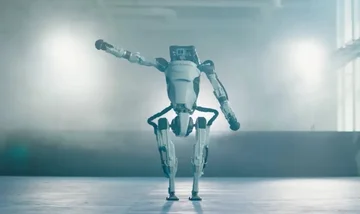 Boston Dynamics Puts Its Hydraulic Atlas Robot Into Retirement Eleven years of hydraulic engineering had been relegated to the museum. The architectural argument Xingxing and I had agreed on in the hallway in 2017 had been validated by the one company in the world that had spent the most resources arguing the other side. By that point, Unitree was the company global robotics labs benchmarked against. Xingxing had moved into humanoids with unusual speed, and the reason was the one I had not fully understood in 2017: he had spent six years industrializing actuators. The motors, the drivers, the reducers, the manufacturing relationships, the iterative cost-down across thousands of quadruped units - that was the moat. Unitree is now heading for an IPO at a valuation in the range of 42 billion RMB - roughly 25 times trailing revenue, on a profit number that contracted by half in Q1 2026 as price competition intensified. At this multiple, Unitree is trading on a humanoid market that has not yet arrived. The honest reading is that the early thesis electric drive, quadruped as foundation, founder who could survive the dark stretch has been validated. Whether the humanoid market arrives on the timeline the price implies is itself a bet, and not one I would make with high confidence today.
But the bet isn't the only reason this story matters to me. In 2014, GeekPark brought Elon Musk to China and put him on stage next to an almost-unknown 31-year-old founder named Zhang Yiming. Neither was a household name yet. Three years later, we did it again: a 27-year-old in a Hangzhou garage, working on a category that didn't yet exist, in a year when every other check in Chinese venture was going to shared umbrellas. What was different the second time was what we could do about it. In 2014, we had a stage. By 2018, we had a community, a fund, and the willingness to wire money to a founder burning through his own savings to keep his company alive. GeekPark has never been a typical investment institution. The fund is one expression of something older underneath it: a community that tries to recognize the right person on the right trajectory before the consensus does, and tries to be useful in whatever way the moment requires. Sometimes that's a stage. Sometimes it's an introduction. Sometimes it's a wire transfer on a day when the math says wait. Unitree as a company today is something none of the people in either of those rooms could have drawn a straight line to in 2017. The thing that began as a conversation on a hallway couch, and limped across a doorway threshold at an awkward afternoon tea, became larger than the bet that started it. The dog stumbled. We wired the money anyway. That was the bet I made.