At AGI Playground Singapore, Genspark made its stage debut with a new product: GenOffice, a full AI office suite (docs, spreadsheets, slides, PDF). Free, open-source, PC and Mac. One engineer built it in a week.
Genspark has gone from AI search, to general-purpose Super Agents, to a full AI Workspace, and each pivot has landed on an inflection point in the technology. The bet behind all of it: models will commoditize as they compete, so the durable moat isn't the model, it's the context. Pull a user's work data, habits, and history onto one platform, and AI stops being a tool and becomes a work partner. The endgame Jing describes in one line: work does itself.
He's clear-eyed about the odds. 99% of AI startups fail. Genspark is building to be the 1%, and Jing thinks that window is still open.
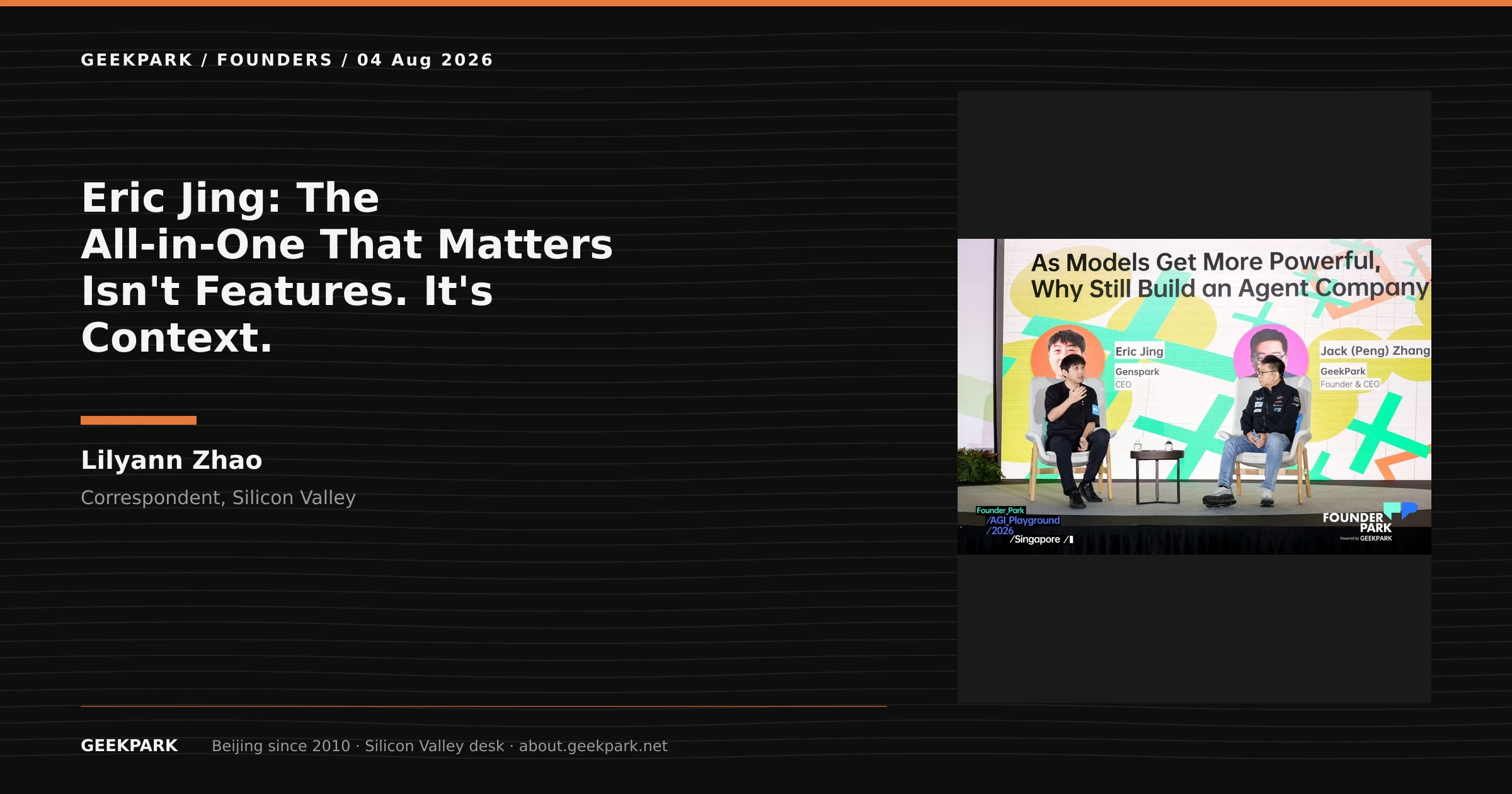
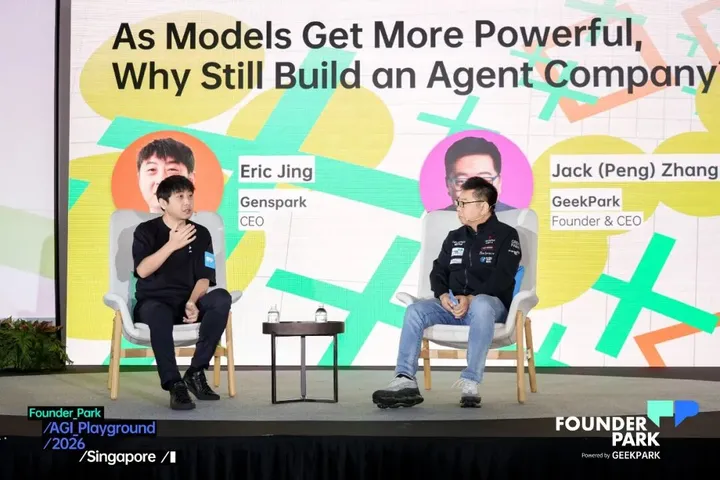
On August 3, GeekPark founder Jack Zhang sat down with Eric Jing at AGI Playground 2026. The full conversation follows, edited by Founder Park (Founder's community of GeekPark).
01 Users Always Seek Better Tools - Standing Still Is the Real Risk
Jack (Peng) Zhang:
Let’s start with a product you’ve already iterated past - AI search. It was Genspark’s starting point, and you had over 5 million users when you decided AI search wasn’t the endgame for the company, shifting instead to explore new product forms. Can you take us back to that decision moment? What did you see that made you commit to this change?
Eric Jing :
Let me add a bit of context first. I joined Microsoft as a software developer in 2006 and spent most of my career working on search. Over my 20-year career, it all boils down to one thing: building products that connect people with information.
The essence of search is matching people with information. Before founding Genspark, I worked with billions of user queries and learned one key truth: people don’t use search for search’s sake, or just to find web pages - they use search to get things done. People want to complete entire tasks more simply, and spend less time on tedious busywork.
Back in our early search days, we tried all kinds of ways to optimize the experience. Our team even positioned Bing as a “task engine,” trying to help users complete entire workflows end-to-end. But 20 or even 10 years ago, the technology wasn’t mature enough to deliver on that vision.
That all changed when ChatGPT arrived. We suddenly realized this AI technology could actually turn that long-held dream into reality: AI could take over all operational work, and humans could focus on creativity. That was the founding vision for Genspark AI.
From day one, we wanted to build an autonomous Agent that could complete tasks end-to-end. But at the time, base model capabilities weren’t strong enough. As a startup, we couldn’t afford to wait around for perfect technology that might never arrive on our timeline. We had to survive first.
So we had to find the most basic, realistic Product-Market Fit (PMF) with the AI capabilities available at the time. Two years ago, AI search was one of the clearest PMFs in the market - so that’s where Genspark started.
Then Claude Sonnet 3.7 launched. It was the first model that made end-to-end, full-process Agents practically feasible. The moment we saw that signal, we knew it was time to evolve Genspark toward end-to-end task completion.
Outsiders call this a pivot from AI search to AI Agents, but for us it was a natural extension. The technology we’d been waiting for was finally here. We wanted to bring it to market as fast as possible and turn Genspark into a truly AI-native work experience.
Jack (Peng) Zhang:
For you, this was the moment to deliver on the company’s mission. But 5 million users is a massive milestone for any founder. Did you assess the risks of making this transition?
Eric Jing:
It’s not that I saw no risk in transitioning - it’s that I saw far greater risk in standing still and missing the opportunity. Users are always searching for better tools. Even if a new tool feels unfamiliar at first, once people try it and see it’s significantly better than the old way, they’ll migrate.
Our user transition was incredibly smooth, because this was fundamentally a step up in experience. Instead of reading AI summaries and clicking through web pages, users could generate a full presentation or complete tedious document work with a single prompt. For users, it was a pure upgrade. That’s why the transition was seamless for both us and our user base.
Jack (Peng) Zhang:
So in your view, the risk of inaction far outweighs the risk of iterating forward?
Eric Jing:
Exactly. Standing still and missing the opportunity is the far bigger risk.
Jack (Peng) Zhang:
Honestly, the pace of AI product iteration over the past two years feels surreal. We’ve gone from chatbots to AI search, general-purpose Agents, and now AI Workspaces - all in just two years. I’ve been trying to unpack the core drivers. Is it purely model evolution, or are other factors pushing this forward?
Eric Jing:
AI is fundamentally different from every traditional technology we’ve seen over the past 20 to 30 years. I’ve lived through multiple technology shifts - from the personal computer era, to PC internet, to mobile internet. Past technology iterations followed a familiar pattern: talented teams in a given space would iterate and polish the same core technology, making incremental improvements day by day. But AI is an entirely new species. It evolves so fast that every new model release can unlock entirely new possibilities.
It’s like compressing a century of progress like the electric power revolution into just 5 years. That’s why AI is changing so fast it’s hard to keep up - and it’s only accelerating, with no sign of slowing down. That’s the first point: the inherent nature of AI technology is fundamentally different from previous tech generations. The second point is that the entire ecosystem was already primed for AI.
Over the past 20 to 30 years, our daily work has been taken over by all kinds of software and services: email for communication, CRMs for customer data and conversations, online meeting tools for discussion records. A massive amount of digital assets has already accumulated. This work context has been “maturing” for 20 years, just waiting for the AI era to arrive. When mature data context meets fast-evolving AI technology, they create a flywheel effect: the more context you feed a model, the better it gets at solving everyday tasks. This flywheel is what’s driving the digital workspace to evolve so rapidly - users get a noticeably different experience every single day.
02 The True All-in-One for AI Is an All-in-One Context
Jack (Peng) Zhang:
We’ve known each other for years, and I know you’re a firm believer in the “All-in-One” product philosophy. But what I see today is that most people still do things the old way across many scenarios. Meanwhile, you’re building fully AI-native products rebuilt from the ground up - yet you’re still committed to the All-in-One approach. How does that align with your product philosophy?
Eric Jing:
I am a firm believer in All-in-One products. Many of the greatest products in history are fundamentally All-in-One: search is All-in-One, the smartphone is All-in-One, WeChat is All-in-One. It’s a proven path: you build a simple, easy-to-use interface, and keep adding more capabilities into it over time.
In the AI era, I think we’re one of the first companies to put this All-in-One AI concept into practice. And I believe more and more companies will come around to this direction - All-in-One is the future.
But the All-in-One I’m talking about is centered on context, not features. Models are important, of course, but our judgment is that over time, models will gradually become commoditized infrastructure.
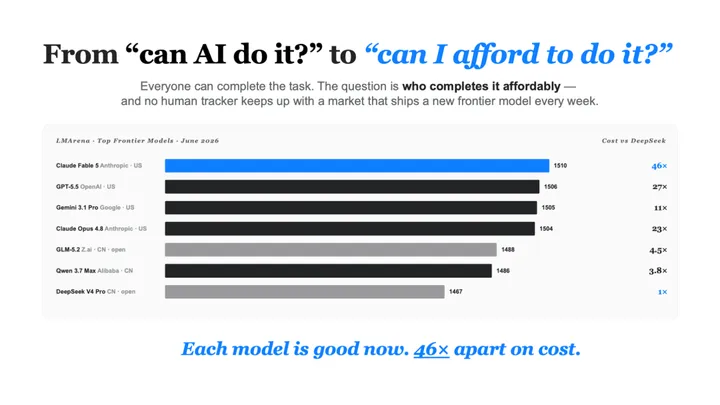
Let me show you a slide - this is updated from just two weeks ago. New models are launching constantly: we’ve already seen Kimi K3, DeepSeek V4, and many others. On one hand, every model today is already very capable, each with slightly different strengths for different tasks. On the other hand, the cost gap is enormous - the most expensive models can cost up to 50 times more than the cheapest ones. Most people have no idea which model to use for which task, and the same goes for enterprises.
Three months ago, I attended a closed-door CEO summit hosted by Microsoft. There was an anonymous poll, and the number one pain point for CEOs right now is not knowing which model to bet on - AI is iterating too fast. Another 24 CEOs said that even after spending heavily on AI services, they worry their teams won’t actually use them. The first problem is model selection paralysis; the second is usability.
Behind these numbers is a simple reality: there are too many models on the market today. People don’t have the time to test them all, or the expertise to judge which ones are good. And cost is becoming an increasingly big concern. That’s where companies like ours come in: we sit in the middle, translating raw model capabilities and parameters into simple, powerful, easy-to-use platforms.
Our version of All-in-One has two layers.
The first is model All-in-One: we bring all models together in one place, matching the optimal model to each task. This saves users money while delivering top-tier performance.
The second is context All-in-One. Building a unified interface is easy. But today, knowledge workers’ data is scattered across dozens of apps and services. People are constantly copying and pasting work context from one tool to another. If we can consolidate all that context in one place, the platform can fully understand your work habits. Combined with our broad model selection, it can become your true work partner.
When you need to get something done, a partner that has all your work context at its fingertips can handle it efficiently and cost-effectively. That’s the future we believe in.
We keep adding features and improving capabilities, but the goal is always to capture more and broader horizontal context. The essence of All-in-One is aggregating all the horizontal context from across your work life. With unified context and a unified brain, an All-in-One platform can deliver high-quality results automatically, at low cost and high efficiency. That’s why I’m convinced All-in-One products in the AI era will not only work - they’ll create enormous value for users and enterprises.
Jack (Peng) Zhang:
So the very concept of “All-in-One” is evolving. It used to mean packing different features into one app with one UI. Now the more important part is that all products share the same core context.
Eric Jing:
Exactly. This is a new generation of All-in-One philosophy. The concept itself is evolving. The old definition - one interface with many features stacked inside - still holds true. For AI products, that means a web interface with different sub-Agent capabilities built in.
But as I said earlier, AI technology changes the whole equation. If one person can build a full-featured office product in a week, why make users come to Genspark? Why not bring the service to their doorstep? Why not open the restaurant in their neighborhood, and deliver the food right to their home?
That means letting users get tasks done in the interfaces they already know and use every day - while we capture that work context at the same time.
Jack (Peng) Zhang:
Using technology to create greater value. That’s the new variable this era gives all founders.Now, many founders are hunting for new AI use cases and untapped user value. From your experience, are there any scenarios that you didn’t expect at first, but ended up becoming core sources of user value? Can you walk us through some examples?
Eric Jing:
There are quite a few, actually. Two years ago, we were one of the first companies in the world to launch an AI presentation product. When we first released it, a lot of people pushed back: who makes business presentations in HTML format? Everyone wants PPT files - that’s what looks professional. But from our perspective, HTML is one of the most native file formats for large language models.
Building presentations in HTML lets you generate higher-quality content with better layout and design. Then users told us that for some use cases, HTML versions work perfectly - like sharing information with teammates, where format doesn’t matter but editability does. So we built an online HTML slide editor. Then users asked: the online editor is great, but can I edit these HTML slides in my desktop PPT software? So we built an Office plugin. Then users said the plugin was too expensive and too slow - so we went ahead and built our own native GenOffice from scratch.
We don’t build products in a vacuum. We listen closely to user feedback. Every time we ship a new feature, users come back with new requests, pushing us to make the product better. That’s how we iterated from a basic online AI slide tool to a full-featured desktop office suite. The email client you see today is another example born directly from real user pain points. I use email every day - it’s one of my most-used apps for work communication. But I constantly struggled with the same problem: when I need to find an important email, I can never remember the details to search for it. So we thought: why not build an Agent directly into the email client? We use this email client ourselves every single day.
For example, when we were planning this event, I asked our email Agent to go through all my correspondence with Geek Park, pull together the full schedule, extract the PDFs from attachments, block time on my calendar for each session, and even draft emails to your team in my tone to suggest small tweaks to the agenda. These are small, granular needs, but they’re absolutely core to daily work. If you really dive into scenarios and listen to users’ real pain points, you’ll find enormous opportunities to reimagine traditional software and services. That’s been our core learning along the way.
Our product philosophy at the company is pretty simple, just two rules: First, build products we love and trust ourselves. Don’t build products for other people - build them for us first, and be honest with yourself. We are the first users of our own products. If we don’t love using it every day at work, if it doesn’t solve our own real problems, it’s not ready. Second, we believe there are lots of people in the world just like us, with the same pain points. The more universal and common the pain point you define, the more users it will resonate with. So our approach is: build it for ourselves first, make something we love to use, then trust that more people will feel the same way. That’s our product methodology.
03 AI Value Lives Beyond the Model Layer - The Translation Layer Matters Most
Jack (Peng) Zhang:
Speaking of this, it feels like the definition of “general-purpose Agent” is shifting. At first, everyone talked about Super Agents that could do anything. Now it seems like the priority is doing specific things really, really well.
Eric Jing:
We’ve always maintained an open and respectful attitude toward new technologies. We even try to unlearn all the experience we’ve accumulated over the past 20 years - because new technology is a whole new species, and you can’t judge it by old rules.
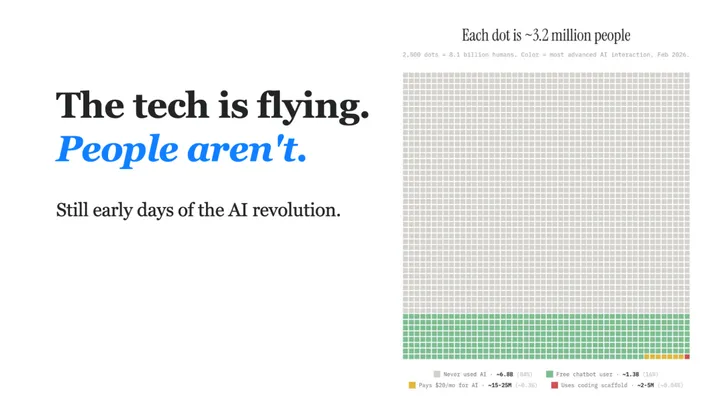
Let me show you another set of data. This chart went viral in the industry back in February. Each dot represents 3.2 million people. The gray dots are people on Earth who have never used AI. The green dots are people who have used AI for free. The yellow dots are people who pay $20 a month for AI. And that single dot all the way on the right - just one dot - represents people who use Super Agents and Coding Agents.
That’s the reality I build products for. We want to build a company that stands the test of time. I’m under no illusions: 99% of startups fail. But even with those odds, we want to chase that slim chance of building something great.
When I look at this chart, I think: if we want the vast majority of people on Earth to use AI, we can’t just build cutting-edge experiences that only a tiny fraction of power users can understand. We have to meet people where they are. We can’t make users come to us - we have to go to them.
The old technology playbook was: open a restaurant, and invite people to come dine with you on weekends. But with AI technology, we can open that restaurant right on your street, and deliver the food straight to your door.
That’s our core internal principle:
meet users where they are. Building client-side software used to be incredibly complex, with extremely high barriers to entry. Today, those barriers have dropped dramatically. So why not work with users’ existing habits, deliver service through interfaces they already know, and lower the learning curve?
And as users use the product, we capture their work context, aggregate that data back, and build out that unified brain, that unified context. That’s why I believe being a good “translator” between models and users is so critical.
We have another analogy we use internally. Coding Agents are like supercars - incredibly powerful for developers and researchers, but they’re single-seater vehicles. Only expert users can really get the most out of them.
What we want to build at Genspark is a self-driving car that goes just as fast. You can pick any model you want, it runs in the cloud with unlimited compute, it always stays state-of-the-art - and you never have to worry about “driving” it. It handles everything itself.
If we can deeply understand the strengths and characteristics of every model, we can stand right at the intersection between models and users. That intersection touches consumers and enterprises, software and hardware. Players who stand at that crossroads get access to an enormous amount of context data.
Jack (Peng) Zhang:
That really does build a unique moat.Which leads right into my next question. You’ve grown very fast - your Annual Recurring Revenue (ARR) is already over $250 million and still growing. But there’s a common critique of Agent companies right now: that they’ll end up as nothing more than distribution layers for model providers, just middlemen selling tokens for a small cut. What’s your response to that?
Eric Jing:
First of all, we don’t see ourselves as an “Agent company” - we’re an AI company. Two years ago people called us an AI search company. Today they call us an AI Agent company. Tomorrow they’ll probably call us an AI Workspace company.
In my view, the AI revolution has barely started - we’re maybe 10% of the way through. Product forms will keep evolving. What we want to build is an AI company centered on All-in-One context.
For AI, the most critical thing is continuously compounding context, building that context flywheel: the more context you feed into the unified brain, the smarter and more personalized it gets.
As for the “distribution” argument: I’ve traveled all over the world studying what makes successful companies work. For some core products at companies like Microsoft and Google, distribution channels drive 80% of revenue in certain markets. Distribution itself is a moat. It’s not a dirty word. If we can build enterprise-grade distribution capability, that’s already extremely valuable.
Let me use an analogy to explain the early-stage industry landscape. Large model labs are like fishing companies - they supply the raw material. Coding Agents like Cursor are like high-end sushi restaurants, specializing in one vertical. Platforms like OpenRouter are like wholesale distributors.
And Genspark? We’re the neighborhood chain restaurant that delivers right to your door. Fish is just one of our ingredients. We turn it into different dishes, tailored to your taste.
In other words, we build massive amounts of value-added work on top of models. Nobody calls Apple a “hardware component distributor” - because Apple does enormous integration and innovation on top of those components. It’s the same for Genspark. Inside our All-in-One workspace, we’ve built extensive tooling, orchestration frameworks, and our own Agent-friendly file system. We aspire to be the kind of integrative, innovative product company Apple is.
04 The AI Era Will Give Rise to a Trillion-Dollar Application Company
Jack (Peng) Zhang:
Your global expansion has been really impressive. You’re not just growing in the US - you’re seeing explosive growth in Korea and Japan too. What’s the key decision behind that success? How did you pull it off?
Eric Jing:
The US, South Korea, Japan, France, India, and Brazil are all our core markets today. I’ve traveled all over the world, and you definitely feel the differences between markets. But if you look past the surface, at the core it’s all about human needs - and those are universal. Take New York, for example. We were one of the first companies to advertise heavily in the New York City subway.
We did a very concentrated ad buy there. New York is a unique city: it’s almost hard to believe how often people lose cell signal on the subway. That time with nothing to do but look at ads is an incredibly high-intent scenario. User habits also differ. A lot of New York users work in finance and investing, and they live in Excel. In Japan, people commute by subway and taxi heavily, and they’re power users of PowerPoint. South Korea has a huge design industry, so people use all kinds of design tools constantly. Those are the surface-level differences. But the underlying logic is the same.
I come from a search background, and this is where search taught me a huge lesson: search is an incredible product. When I worked on search, we didn’t care where users came from, who they were, or how old they were. We only cared about their query, and matching that query to the right web page. Do that well, and you can serve millions of people - without ever even knowing who they are. That’s where I learned the principle: great products acknowledge differences, but abstract them away into universal solutions. Users in New York need to build presentations too. Users in Korea need to work with spreadsheets too.
You just adjust the priority and weighting of features based on the unique traits of each market. Every time I visit a new market, I talk to local users and enterprise customers, and we adjust our roadmap priorities accordingly. The end result is a product that acts like a “global citizen” - it works everywhere. That’s how we’ve approached our global expansion, step by step.
Jack (Peng) Zhang:
We’ve known each other a long time, and I remember you saying two years ago that the AI era would give rise to a trillion-dollar company. Do you still believe Genspark has a shot at reaching that scale?
Eric Jing:
99% of startups fail. At Genspark, we operate with that sober reality front of mind, and we do everything we can to be the 1% that survives. I think there’s still a very narrow path to that trillion-dollar goal. We’re aiming for it, and we’ll work as hard as we can to get there. One trend I’ve observed recently: if you take today’s model intelligence level as a baseline, in two years the cost of that same level of intelligence will drop to 1% of what it is today.
People have different takes on the industry, and I fully respect that. But our observation is this: competition among large models is heating up fast, and under that pressure, model supply will trend toward homogenization and commoditization. When models become infrastructure, value shifts to the middle “translation layer” - to product companies, just like Apple in the PC and smartphone eras.
If we can integrate 70 or 80 top-tier, multi-modal models on a single platform, and build up unified user context so we truly understand our users - combining those two strengths while standing at the intersection of all parts of the ecosystem - we can automate most of people’s daily busywork. If we get there one day, our value will be that of an AI company that truly understands its users and solves their problems.
The more work we help you with, the better we get at helping you with the next task. Someday, people might only need to do two things at work: approve, or send back for revision. All the repetitive work will already be done by AI. You just decide “yes, go ahead” or “no, do it differently.” That’s why I believe AI application companies have a real shot at reaching trillion-dollar scale.
Jack (Peng) Zhang:
The past couple of years, VCs have been obsessed with investing in young founders. The logic goes: young people don’t have the baggage of old ways of doing things, so they’re better suited for a new era. But you’re a very successful serial founder, and you don’t fit that traditional “young founder” mold. I’d love to hear your take: what role does age actually play in AI entrepreneurship? And what matters more than age?
Eric Jing:
Before I answer that, let me quickly add one observation about enterprise AI. AI iterates so fast. A few months ago, everyone was talking about “token stacking” - chasing maximum model capability. Now in the US, the trend is “token optimization” - which is really just a fancy way of saying cost reduction and efficiency gains. In enterprise, no company wants to bet their entire stack on a single model. Models change too fast. So cost optimization is now the mainstream conversation in enterprise AI, and open-source models are gaining traction globally. These are the market signals we pick up on, and we adjust our solutions accordingly.
Going forward, I think closed-source and open-source models will converge. Enterprise users want the same thing: strong model capabilities, and reasonable cost. That’s the industry reality right now. AI is moving so fast that it’s easy to get caught up in the hype. But I think it’s important to maintain an open, rational mindset toward the technology. That’s my take on enterprise AI and where model competition is headed. Now, back to the age question. We have a mix of young people and very experienced people at Genspark. I know some cultures place a huge premium on youth. But if you look at Silicon Valley - the founders of OpenAI, Anthropic - none of them fit the classic “young founder” stereotype.
They’re all deeply experienced practitioners. I read a book once that made a point that stuck with me: the brain works like a filter. As you get older, that filter gets stronger. When you learn new things, less of that new information actually makes it through the filter and into your brain. But the more people I meet, the more I realize how much variation there is. There are plenty of highly experienced people who still have incredibly open minds toward new things today - even after they’ve become very successful, they’re still writing code themselves. People like that are incredibly powerful. If someone has deep industry expertise and the energy and open-mindedness of a young person - they’re basically superhuman in the AI era.
That’s why biological age is never a hiring criterion for us. What we value most are mindset, intellectual openness, self-motivation, and bias for action. Those are the core factors we use to evaluate talent. Younger people may have a higher percentage of folks with that open mindset. Among more experienced people, that percentage might be lower. But when you find someone who combines experience with openness, their output is far beyond average. That’s how we approach hiring and talent.
Jack (Peng) Zhang:
Age doesn’t matter - mindset does. Thank you so much for sharing, Eric. I hope you keep finding new horizons and new discoveries along this journey, and enjoy every step of it. We’d love to have you back at AGI next year to show us what you’ve built in the year ahead.