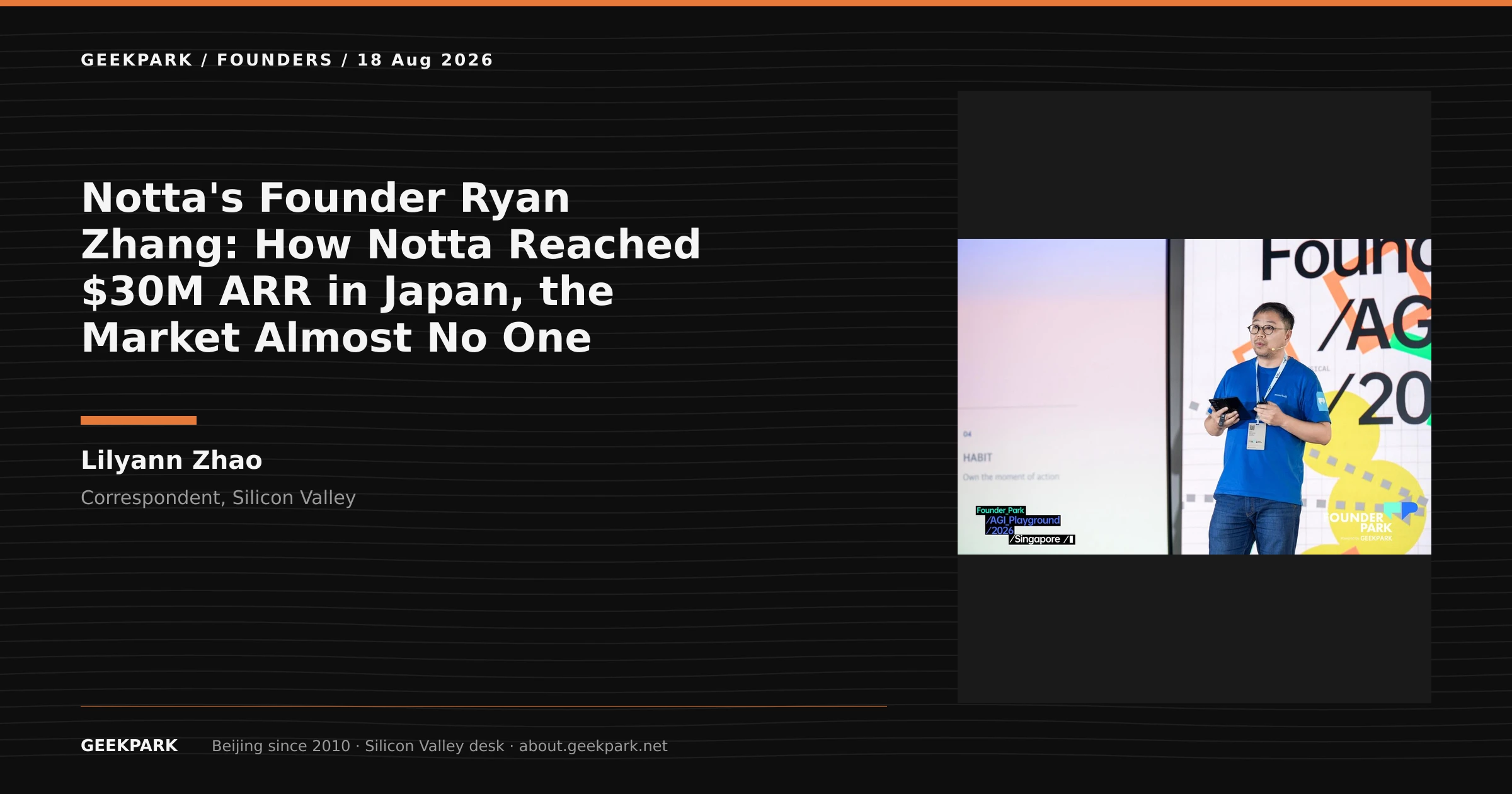
Most founders building for the world reach for the US first.
Ryan Zhang, the founder of Notta, picked Japan. It is a market almost no one goes into on purpose. The language is hard, user satisfaction has run negative for years, enterprises decide slowly, and the part that matters most is that trust takes years to build.
Against that, Notta reached $30M in ARR, more than 10 million users worldwide, and coverage across 68 of the 225 companies in the Nikkei index. The market is hard to crack. Once you crack it, the difficulty turns into a moat.
"If these difficulties aren't fully out of your control, if you can solve them through product, service, and organizational capability, then they become your natural moat. Once we actually built the language quality, the local growth, the customer service, and the trust in Japan, it got very hard for anyone behind us to copy the whole thing by translating their website into Japanese.""What Japan gave us wasn't only revenue and users. It was a capability to localize deeply."
This year Ryan brought a new product, SpeakON, a piece of AI voice hardware. And he turned from Japan toward the US.
On the AGI Playground 2026 stage, Ryan walked through his thinking from 2020 to today: why he chose the counterintuitive Japanese market, how Notta grew there, how far the localization of an AI product actually has to go, and why, after five years of SaaS, he went back to hardware.
What follows is Ryan's talk at AGI Playground2026, GeekPark's Singapore edition summit.
01 Playing the Long Game in Voice
I started building companies back in 2014. The first was Mobike. After I left Mobike, I stayed in AI voice and never really left. Since 2016, everything I've worked on has been voice.
The theme today is Playing the Long Game in Voice. People talk about long-term thinking all the time. What does it actually mean? To me it's like playing a game. At each stage you build a different capability, and only once that capability is in place can you enter the next stage. When you do, and the capability is there, you can grow faster than before.
The first layer is utility. Does your product solve a problem that hurts enough? Notta started from a very small point inside a workflow and solved one painful problem. After people used it, the reaction was: finally, I don't have to do this myself anymore.
The second layer is distribution. Once the product exists, can users find you in the language and the channels they already know?
The third layer is trust, especially once you're selling to companies. Why would a customer hand you their data, their process, their budget?
The last layer is habit. In the exact moment a need shows up, does the user think of you first? Does the answer just come out as Notta?
Watching Notta grow, I saw utility, distribution, and trust stack up one on top of the other. Today we also launched a new product, SpeakON. It's my attempt at that last layer: can a piece of hardware become a habit, can it hold the moment a user has an idea and turn that into a routine?
The form changes. The underlying task doesn't.
Looking back, the products I've built are pretty different from each other. In 2017, 2018, 2019, I built smart translation devices, all tied to language and voice. Then in 2020 I started Notta, a SaaS plus AI business. Notta now looks a bit like one of those AI OG products. And now there's SpeakON, software plus hardware.
Some people might think I keep switching directions. The way I see it, the form of the product changes, but the underlying Voice AI doesn't.
The translation device solved the problem of not sharing a language. Notta solved the problem that after a meeting, you still have to record, organize, and write up the minutes. With SpeakON, the problem is this: you have an idea and you want to capture it fast. In the past that took a lot of steps, unlock the phone, find the app, type it in. SpeakON strips all of that friction out.
There's another thing. People speak far faster than they type, and when they speak they usually carry more context, because typing is a hassle and you don't want to type much. Voice always had one big problem: it produces a pile of raw material that you then still have to process. For years I've been looking at the same question. Is there a way for voice to not just get recorded, but to turn into a task you can hand off directly?
The product changes, the market changes. The core task underneath hasn't.
02 Why Japan: The Difficulty Itself Is the Moat
Choosing Japan wasn't a mainstream call at the time. For a company that wants to go global, the usual instinct is the US, or Southeast Asia, some market that's easier to enter.
What is Japan usually like? The language is hard. Users are extremely demanding. I don't know how many of you have looked into this, but the user satisfaction of Japanese software products, the NPS, is usually negative. A score of minus 15 already counts as decent, while in the US it's often around 65. Enterprise decisions are very slow. Trust takes a long time to build.
That all sounds like a list of drawbacks. But flip it around. If these difficulties aren't completely out of your control, if you can solve them through product, service, and organizational capability, then they become your natural moat. Not everyone will go into Japan right away, and not everyone can reach the level of trust we reached.
Which means once we actually built the language quality, the local growth, the customer service, and the trust in Japan, it got very hard for anyone behind us to copy the whole logic by translating their site into Japanese.
So what Japan gave us, I think, wasn't only revenue or users. It was a capability to localize deeply.
Choosing Japan wasn't only about TAM, the largest market a product could theoretically reach, or the fact that Japan has more than 100 million people speaking one language. There were a few more practical reasons.
First, the pain point is very clear. Japan is like Germany in that it adopted a parliamentary system early, which produces a huge volume of meetings and client visits. After a visit you spend a lot of time turning speech into minutes. That work is concrete and very frequent. A new employee in Japan has to write down every word of a meeting and hand it to the boss. That's a high-frequency need Japan already had.
Second, Japanese ASR has a real barrier. Plenty of global products say "we support Japanese," but supporting Japanese and actually designing for local Japanese users are two completely different things. Recognition accuracy, how the interface reads, the localized workflow, the way support replies, all of it shapes the real experience.
Third, Japanese users are relatively willing to pay. As long as you save them time and make the work clear enough, they can see the value.
Last, and to me the most important, is trust. Japanese users don't just look at features. They look at who the company is, whether you've told your story in the media, whether they can find you when something breaks, and how fast you respond. All of that is part of your product.
For me, a market with no barrier at all is easy to enter, and easy for anyone else to enter too. The hard parts of Japan happen to be things you can turn into your own capability through long-term investment. That's one of the main reasons we chose it.
03 From a Simple Tool to $30M ARR
Pull Notta's path into a single line.
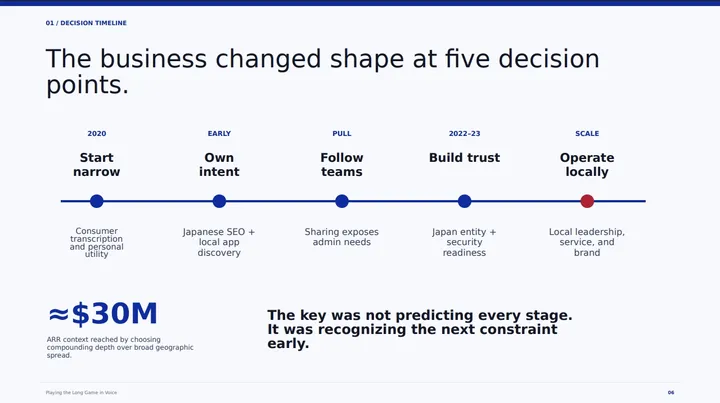
In 2020 the product was very simple. Just an app. You could record in real time, upload MP3 and MP4 files, and quickly get a written document, the gijiroku, meeting minutes you could use directly. There were no large models then. We could only run NLP models for entity analysis, pulling out numbers, places, and other domains. That was AI from the previous era.
Once the need was validated, the next question became: where do the users come from? We started doing SEO in Japan, building growth strategy and localization, all of it around how Japanese users search.
One of our earliest customers was Yachiyo Engineering, a Japanese firm that does consulting for nuclear plants and water projects. Employees inside the company bought Notta themselves, then started sharing files with colleagues, and that's when the B2B needs showed up. Who can see this? Who pays? Who owns the data? Can the security team approve the budget? The product was starting to shift from B2C toward B2B.
By 2023, what limited Notta's growth was no longer a product feature or an ad budget. It was: how do you run B2B marketing in Japan? Do you have a Japanese legal entity? A local team? Local compliance, procurement processes, customer service handoffs, those became the bottleneck.
When we worked with Japanese enterprises, a customer would hand us a security sheet with something like 100 rows and ask us to fill in every line. What level is this? Where does the data live? Does the company have access control at the door? Are there cameras? Around a hundred rows, and every company's sheet is a little different. You get a sense of how seriously Japan takes trust and compliance.
Through all of this we grew revenue to roughly $30M in ARR. Every stage was painful, and each one demanded a different kind of growth.
SEO wasn't only acquisition. It was a market-sensing system.
Notta didn't start as meeting intelligence. It was a simple voice-to-text tool. Meeting intelligence sounds big, but early users don't care what the thing is called. All they want is: I sat in a meeting for an hour, don't make me spend another hour going back through it to organize the information. The task is simple. Let the user search, edit, process, and share quickly. We spent an enormous amount of time on that experience.
A lot of early-stage founders paint the endgame too perfectly. They treat the product like their own kid and want him to play basketball like Yao Ming, run hurdles like Liu Xiang, and shoot photos like a famous photographer, all at once. You don't have to see the product perfectly at the start. Find the few strengths that matter most and sharpen those. Users don't stay because you take great photos. Maybe they stay because you're tall. Do one thing well first, then think about how to expand.
In Notta's early days, SEO was extremely important. Japanese users were already searching how to write meeting minutes, how to turn speech into text, how to caption a video. We didn't have to teach them these problems exist. We just had to make Notta a clear enough answer. For every task and every search keyword, we built a page telling the user how to get that job done.
We never did programmatic SEO, the kind where you use AI to churn out piles of abstract copy about changing the world. We wrote serious articles about how to actually use AI better. And the search terms kept telling us how users described their own problems, which fed back into how we improved the product. We turned SEO into a market-sensing system. It brought in users and helped the team understand the market at the same time.
No channel is the best channel. The order is what matters.
When people look at growth, they list out SEO, ASC, content, case studies, and ask which channel works best. From what I've felt, the list of channels doesn't matter much. The order does.
Here's an example. Early on we switched pricing from dollars to yen, and conversion went up 30 percent. Just localizing the price lifted paid conversion by 30 percent.
The right order, roughly, is this. First, get the basic localization right and optimize paid conversion. Second, use organic SEO traffic to learn what users are searching for, and keep building pillar pages and scenarios that catch that demand. Third, scale revenue through ASC and search ads. Fourth, do the real localization work: customer case studies, local technical support, enterprise sales. That last part answers a different question, which is why an organization would dare to choose you.
The logic behind it is fairly simple. Solve product uncertainty first, then solve channel uncertainty, then solve enterprise adoption risk.
04 Localization Is Not Translation. It Has to Become an Operational System.
An AI product going global usually hits one question: how far does localization have to go? Translate the website and test the water, or register a company, hire a team, and rent an office on day one? I think both are too extreme.
Some localization has to happen on day one. Japanese UI, onboarding, ASR, pricing, App Store copy and screenshots. These basics are part of the product, not just UI and features. If a user's first impression is that this is an English product translated into Japanese, it feels off. They think you're a foreign product.
Other things are very important and also very expensive. A Japanese legal entity, a local sales team, security documentation, procurement support, customer success, an office, long-term brand building. Hiring in Japan is basically lifetime employment. If you want someone to leave, unless you convince them they'd grow more somewhere else and they choose to go on their own, they have the right to stay with you. So people in Japan are very, very expensive.
Which means you land in Japan step by step. Building a team of dozens right out of the gate is agonizing. Before a need is validated, don't globalize for the sake of globalizing, and don't build a heavy organization all at once. That's painful too.
If I sum up what we did in Japan, it falls into about five layers.
First, product: language quality, UI, onboarding, workflow.
Second, transaction: what currency, how users are used to paying, whether the payment channels are smooth, whether you support local Japanese payment methods.
Third, service: response time, whether you offer an SLA, local-language support, whether you have your own customer success.
Fourth, the legal entity: security, contracts, procurement processes, and so on.
Fifth, branding: can the customer form a long-term memory, and when they think of this kind of solution, do they think of you?
In the end, localization is not a translation team, or a marketing team of a few people refreshing social media every day. To actually stick, you need a real team that can serve your Japanese customers and turn all of this into an operational system, one complete setup running from product growth and sales through operations and management.
05 The Shift From B2C to B2B Was Forced by User Behavior
Notta moved from B2C to B2B not because we suddenly noticed enterprise SaaS gets higher valuations, and not because I had the enterprise strategy figured out in advance. Before this I'd only built consumer internet products. I'd never done B2B SaaS. The shift started from one small user behavior: sharing.
One person uses Notta. Then a team uses Notta. Then the team starts to depend on it. At that point the admin has all kinds of questions. How do we handle accounts? Permissions? Who pays the bill? Where does the data sit? Is there a security certification?
To judge the B2B opportunity, we didn't only count how many enterprise inquiries the sales team got. We looked at where the users' output was flowing.
This doesn't mean giving up B2C. Notta still keeps improving its consumer features, the way Notion and Gamma do. But once you're facing enterprises, you find that while you keep stacking features for consumers, the B2B customer says: "You can't open that feature to my employees. Put a switch in the backend. I don't want them using feature A, or feature B." You end up with a pile of switches, which is nothing like the consumer way of thinking.
After we entered Japan, one thing became obvious. Users aren't only buying software. They're buying the company behind it.
The bottom is still the product, of course. Are the daily recognition results accurate? Is the SLA stable? I remember 2024 and 2025, when we spent a huge amount of time on stability. Back then, especially with Japanese enterprise customers, the moment they found something unstable, the CEO would take the team to bow to the customer.
Go up a level and the customer asks: Do you have a legal entity in Japan? Who runs the Japan business? Who's accountable when something breaks? How do you handle data issues? The security team needs certain materials, can you provide them? Higher still, SOC 2, ISO 27001, everything tied to corporate compliance.
Localized onboarding, CSM, an escalation process, do you have all these SOPs?
Early on these things look expensive and seem unrelated to product innovation. But once you reach enterprise procurement, they are part of the product. Without them, the user vetoes you outright, and you have no way into Japanese B2B accounts.
To me, trust isn't a branding word. Trust is getting a user to actually trust you and hand you their budget.
People often ask when a startup should build its brand. My answer is that brand starts on day one. It's not something you do later once you have money, or by hiring a famous agency to shoot a promo film.
What is a brand? A brand is a personality. A friend once told me a brand is like a mother of two who's starting a stockings business. On day one her brand positioning is: I'm a full-time mom working several jobs at once, with two kids.
A startup is the same. You don't need some grand, lofty brand. You need to know what role you play. I'm building in Japan, I'm going after the local Japanese market, I'm solving one problem for the user, and who's my enemy? Right there, your brand already exists. Your competitor isn't Notion, Gamma, or Otter. Your competitor is a concrete direction. Treat that as your product's personality. Get it right from day one and the taste of your whole brand is already there.
06 Why Go Back to Hardware After Five Years of SaaS
Hardware means manufacturing, supply chain, inventory, logistics, after-sales. Every one of those is far more complicated than software. I remember during Notta I even told a reporter I'd never do hardware again, it's too painful, especially the supply chain.
So why start again? Because model capability is becoming very easy to get, and product forms are looking more and more like general-purpose agents. But from having an idea to calling a model, there's still a lot of friction in between. So we started asking: what is the next interface?
I don't think it's another chatbot, another dialogue box. I think it's this: the moment an idea shows up, a very simple physical action, press once and speak, and it goes and executes for you. The hardware itself isn't the intelligence. It's more like a trigger that helps you finish the task at the right time.
Good generative models are spreading fast. Software features get copied fast too. Internally we can ship a very large feature in about a week now, and that's no longer the team's bottleneck. Whether a user forms a new habit just because you have a new product, that's the hard part. Acquiring software users is still very expensive today, and users already face a flood of apps. The competition is shifting from whose model is stronger to who gets activated first, in the moment the user needs it.
SpeakON: an AI physical button.
SpeakON is very simple. It's an AI physical button. You press it, you speak, the task is done. You say the idea out loud, the software cleans it up and drops it into whatever app you're using. It's also an agent router that can connect to all kinds of tools and products.
For example, you can press the button and say: I have a meeting at 3 today, create a calendar event. SpeakON runs a series of tasks in the background. Or you're in Japan, you don't speak Japanese, and you want to book an omakase in Shibuya. You press and say: book it, this time, this many people. The agent handles it in the background.
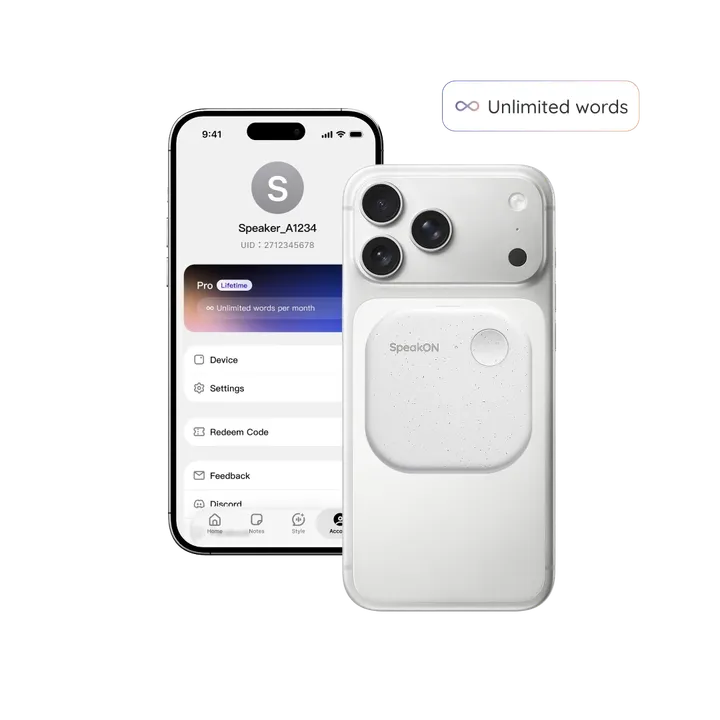
SpeakON is not a voice recorder. It's more like a dictation button, an AI button. A recorder's job is to save the sound, generate an audio file or a transcription. That has value, but afterward you still have to listen, check, distill, then copy it into an email, Slack, a note, or some other doc. In other words, once the recording ends, your task isn't finished.
What SpeakON captures isn't a piece of sound to be stored. It's the idea you have right now, so you can record it fast and execute the task fast.
On the interaction side we split it into four layers. Press removes the activation friction: no hunting for an app, no blank page, just press and speak. Speak removes the expression friction: speaking is faster than typing and carries more context. Polish is where AI actually creates value: stripping out repetition and filler, understanding mid-sentence corrections, adjusting the format to the situation. Deliver removes the transfer friction: the content flows into whatever workflow you need.
Hardware brings a few advantages. People's willingness to pay for a physical product upfront is clearer. It's well suited to reviews, gifting, and word of mouth, because there's an object to show. The device stays within reach, which lifts usage frequency. And a device plus software means one purchase that keeps delivering value. SpeakON needs no subscription at all right now. Buy the hardware and you get unlimited dictation, because dictation costs almost nothing now. A user's whole year runs about $10 to $20.
Japan and the US are two completely different tempos.
In Japan, the first thing Notta had to do was earn the right to scale. Customers look at the company's credibility, its local service, procurement, and whether the brand has been built up over time.
In the US, what SpeakON has to do is earn the right to become a habit, by improving efficiency fast and constantly.
One market emphasizes trust. The other emphasizes whether you can iterate on efficiency fast. Underneath, I think it's the same: how do you build trust locally, then scale globally?
07 Four Basic Judgments From Years of Building Companies
These stints of company-building left me with a few basic judgments.
First, choose a situation that forces the team to build long-term capability. Japan is hard, but the difficulty taught us how to localize and how to build trust.
Second, don't build every capability out on day one. Only when the next layer of capability can open the next stage should you invest in it.
Third, let a business model change user behavior, rather than letting a fashionable concept drive it. The shift from B2C to B2B started because content began getting shared and teams began to depend on it.
Fourth, treat interface and trust as strategic assets. Whether your technical capability turns into value that happens in a user's day is a big part of whether the product wins or loses.
On serial entrepreneurship: the next venture should look a bit different from the last. If it's identical, you might just be repeating a domain you already know, without using what you learned to level up. SpeakON differs from Notta in product form, market, and business model. And the methods Japan taught me carry into this new set of judgments and keep working.
Thank you.