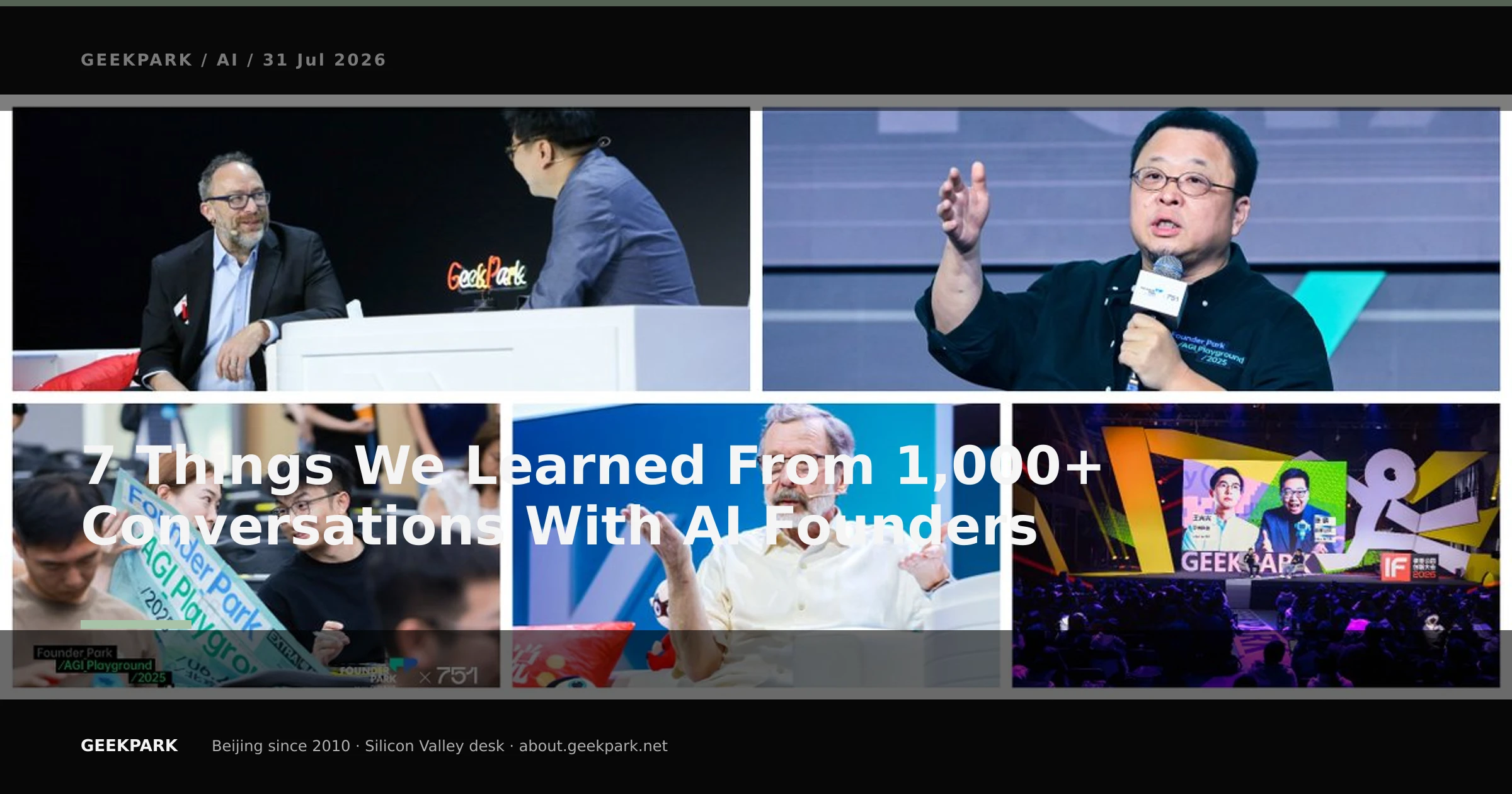
We've spent three years talking to the people actually building AI companies: founders, researchers, investors, and product teams across China, SF, Tokyo, and London.
Not panel discussions. Not keynote fluff. Real conversations. The kind where people say what they actually think because there's no audience.
Here's what keeps coming up.
1. AI made individuals 10x more productive. It made organizations exactly 0x better.
This is the tension we hear most often and nobody has solved it.
Employees are writing faster, researching faster, coding faster. But the org chart? The approval chains? The way decisions get made? All of that is frozen in 2015.
One COO told us: "I have 2026 workers trapped inside a 2015 bureaucracy. The friction is killing us."
The next big unlock in enterprise AI isn't a better model. It's redesigning how institutions actually work when machines are participants, not just tools.
This is an organizational design problem disguised as a technology problem. The companies that figure it out first will have an advantage that compounds for a decade.
2. The model got commoditized. Verticalization became the only real play.
A year ago, you could still argue for building horizontally — broad platform, lots of use cases, grow into it.
That window closed.
Every durable AI business we've watched being built did the opposite: they picked one workflow, went uncomfortably deep, and made their product irreplaceable for one specific person with one specific problem.
When intelligence itself is cheap and everywhere, the moat isn't capability. It's how precisely you've embedded yourself into something people do every single day.
The race to the bottom on model quality is over. The race to the top on workflow depth is just starting.
3. The "agent" conversation went from speculative to operational — fast.
Two years ago people debated whether agents were real. That debate is over.
The questions now are all operational:
How do you build an agent that runs reliably for hours without human intervention? How does it recover when something breaks? How does it actually improve over time instead of doing the same thing on repeat?
The mental model that clicked for the most teams: a good agent isn't a chatbot with more features. It's a new hire that owns a recurring process and gets better with every cycle.
Delegation, not generation. That's the real opportunity.
4. The best AI products got quieter — and that's how they won.
Early AI products had an instinct to fill space. Long responses, detailed explanations, constant output. The model was showing off. Product teams didn't know when to intervene.
The products gaining real traction now are radically more restrained.
One founder told us: "We removed 60% of our AI's output. Retention doubled."
There's a fundamental difference between a tool you use and a product that's integrated into how you work. The latter knows when you need it — before you ask. That's a design problem, not a model problem, and the teams who've cracked it are building something with completely different retention curves.
5. Memory is quietly becoming the most powerful moat in AI.
The default assumption in software has always been: context resets. You close the app, it forgets you.
That assumption is breaking down.
Agents that persist across sessions, accumulate preferences, remember past decisions, and build a model of how you work — that's a fundamentally different product from a smart chat interface.
Here's the compounding effect: once your software remembers you, the switching cost grows every single day. Day 1, it's easy to leave. Day 90, it knows your workflow better than your coworkers do.
The companies thinking about memory architecture right now aren't just building better products. They're building something closer to an ongoing relationship.
6. Going global is easy now. Making money globally is the actual hard part.
Generating international interest for a well-built AI product is almost trivially easy now. Distribution is nearly solved.
But converting that interest into reliable, durable revenue across different markets? That's where every team hits a wall.
The founders scaling internationally aren't thinking about positioning anymore. They're debugging payment infrastructure in markets where their revenue model doesn't translate, creator monetization structures that vary wildly by region, and compliance requirements nobody warned them about.
The moat is in the operational plumbing, not the product itself. The best product in the world means nothing if you can't collect payment for it in Southeast Asia.
7. China's AI story shifted, and the new question is more interesting.
Three years ago, the conversation was all benchmarks. How close are Chinese models to GPT? What's the gap? How fast is it closing?
That framing is mostly gone.
The question now isn't "can China catch up?" — it's "which layers of the stack will China own?"
The model layer is converging globally. But the application layer, the distribution layer, the vertical integrations, those are diverging fast along regional lines. Chinese AI companies aren't trying to build a better GPT anymore. They're building the ecosystems around intelligence that are specific to how business works in their markets. @natolambert 's visit to china also mentioned this.
This is a more interesting story than "catch-up." It's a story about strategic divergence — and it has implications for every AI company thinking about where to compete globally.
The thread running through all of this.
AI stopped being a technology story. It became an organizational design story, a product design story, and a go-to-market story - all at once. The companies winning aren't the ones with the smartest models. They're the ones who figured out how to turn intelligence into something people rely on by default.
That's a much harder problem. And a much bigger opportunity.