This article was published on 21st, May, at @GeekParkHQ.
This was not a normal week in AI, even by the standards of a field that stopped having normal weeks sometime in 2023.
Three things happened that, read separately, look like routine product news. Google announced updates at I/O. Anthropic made an acquisition. Alibaba reported quarterly numbers with the usual superlatives. Read together, they suggest something about where the competition is actually headed — it's not where most of the coverage landed. And China is playing the game differently.
The Google story got framed as a model story. It isn't, really.
Yes, Gemini 3.5 Flash outperforms the previous flagship on coding and multimodal benchmarks at a fraction of the cost. That's significant for developers doing the math on inference spend. But the more revealing number from I/O wasn't on any benchmark slide. It was this: planning-related queries on AI Mode are growing 80% faster than AI Mode queries overall, over the past six months.
That's a behavioral signal. Users aren't just asking questions. A meaningful and growing subset is using AI to organize decisions, set up tasks, think through logistics. Whether that trend continues is an open question. But if it does, it changes what the product actually is — from an answer engine to something closer to a working layer.
At the same time, Google shipped Managed Agents in the Gemini API: isolated Linux sandboxes, versionable behavior files, a runtime that developers can hand off to Google's infrastructure instead of managing themselves. It's a quiet move. Combined with the consumer-side numbers, it puts Google in an unusual position — trying to own both where users start and where developers build. That's a harder thing to replicate than a better model.
Anthropic's acquisition of Stainless didn't get much attention, which is probably a function of how unglamorous the product is.
Stainless generates SDKs, CLIs, and MCP servers. It has, by Anthropic's own account, powered every official Anthropic SDK since the early days of the API. The acquisition brings that capability in-house.
The reason this matters is less about any specific feature and more about what it signals. As agents become more central to how people use AI, the connectors between agents and external tools — the generated SDKs, the model-friendly interfaces, the way developers actually operationalize API access — become part of the product in a way they weren't before. Anthropic is making a bet that owning that layer is worth doing. It's a reasonable bet.
The China angle this week is harder to read cleanly, which is partly why it tends to get flattened in English-language coverage.
@AlibabaGroup's quarterly numbers were strong. Cloud Intelligence Group external revenue up 40% year over year. AI-related product revenue growing at triple digits for the eleventh consecutive quarter, now 30% of Cloud external revenue. The customer base for Model Studio grew eightfold year over year. These are commercialization numbers from a company with existing scale in cloud and enterprise — a different starting position than a standalone AI lab.More structurally interesting: Alibaba has connected @Alibaba_Qwen directly to Taobao and Tmall's product catalog, which spans more than 4 billion items. Agent capabilities now cover order management, logistics, and after-sales service. The practical effect is that the starting point of a purchase can now be a conversation that has access to the full transaction graph — something Western AI products are still mostly trying to build toward through partnerships.
Then there's a development that deserves more attention than it's received.
China Telecom has begun trial token plans starting at 9.9 yuan for 10 million tokens. China Mobile has launched a universal token service in Shanghai, where users access multiple AI platforms under a single account and pay through their phone bill. It's easy to read this as a pricing story. It might be more than that. When AI usage gets billed through carrier infrastructure rather than through cloud consoles or direct subscriptions, it changes who controls the default relationship between users and AI services. Carrier billing has historically been a powerful distribution channel in markets where it took hold. Whether that dynamic applies here is genuinely unclear. But the structural logic is worth watching.

@Baidu_Inc introduced a new reported metric this month: DAA, or daily active agents. The number itself should be treated cautiously — the methodology hasn't been disclosed and the figures are difficult to verify independently. But the framing is worth noting.
Token counts measure inference consumed. DAA, as Baidu defines it, measures tasks completed. If that framing spreads, it would shift how the industry talks about AI productivity — away from input volume and toward delivered output. That's a different scorecard, and on it, the current rankings look less settled.
The through-line connecting these stories is less about capability than about position.
The model race produced clear winners and is still ongoing. But a parallel competition has opened up around something harder to close the gap on: who sits between users and completed tasks, and how deeply that position is embedded in existing infrastructure, billing relationships, and developer defaults.
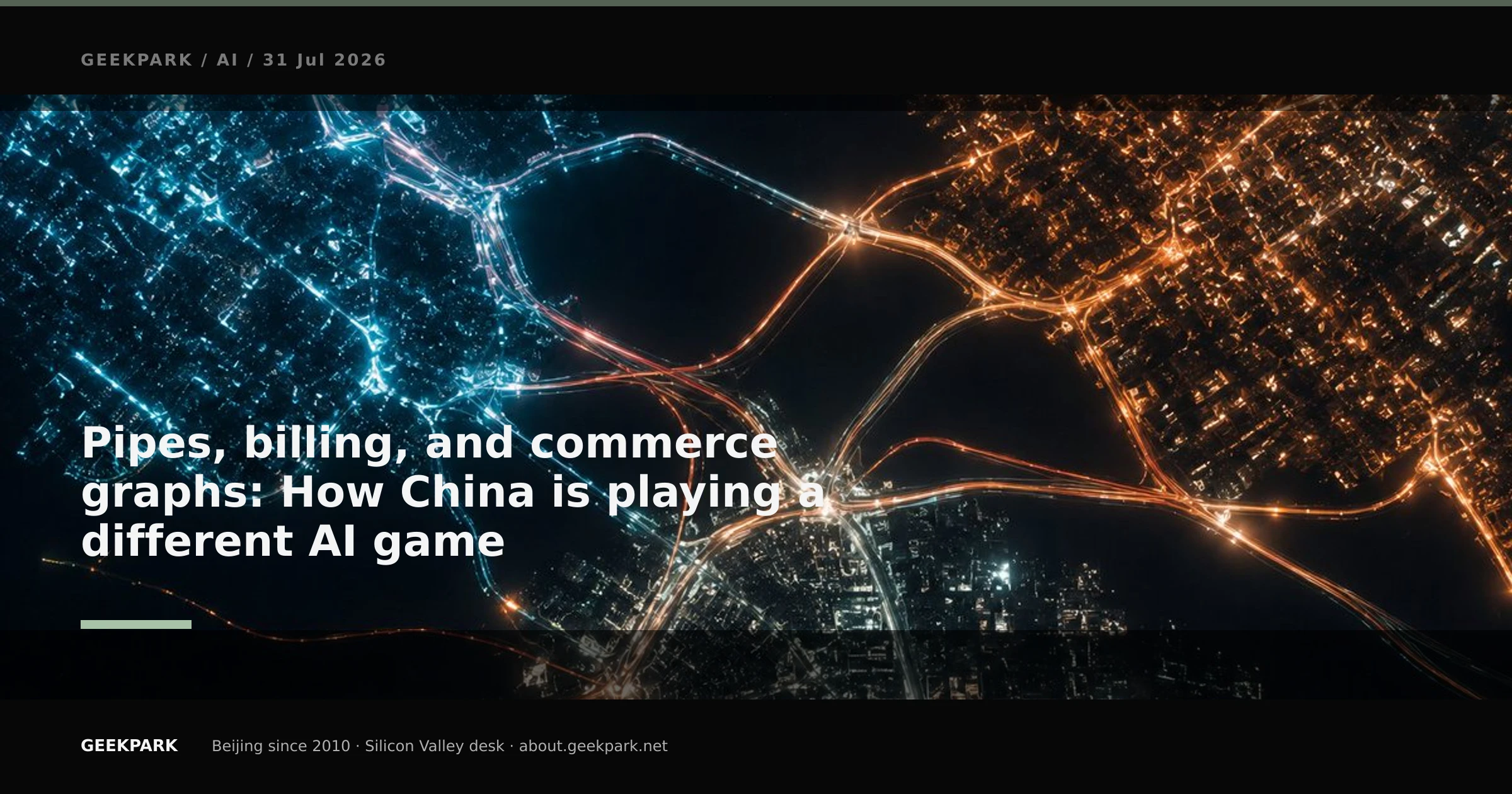
In the US, that competition runs through search, cloud platforms, office suites, and developer ecosystems. In China, it runs through commerce platforms, carrier billing, enterprise workflow software, and tightly integrated service graphs. The companies best positioned in each market are not necessarily the ones with the most advanced models.
Whether that changes the outcome of the broader competition is an open question. It does suggest that reading AI market results through model benchmarks alone is going to miss more and more of the actual story.