He never needed to be the one who got there. He got there anyway.
By Jack Zhang (Zhang Peng), Founder & CEO of GeekPark
*Editor's note: On June 12, 2026, SpaceX began trading on Nasdaq under the ticker SPCX, the largest IPO in stock market history. Priced at $135 a share, the offering raised $75 billion at a valuation of about $1.75 trillion. Then the stock popped, closing the first day up roughly 19 percent and carrying SpaceX's market value past $2 trillion.
With xAI now merged into the company, X along with it, and Starlink driving most of its revenue, SpaceX is finally public. Its market value, like Musk's rockets, went up and down hard before it cleared the atmosphere. The company started in 2002.
Twenty-four years later, Musk and his obsession with space are still questioned, the way they have always been questioned, and the company keeps moving toward the same goal it started with: making humanity a multiplanet species. The piece below was written six years ago, the night Falcon 9 put two astronauts into orbit aboard Crew Dragon. It is one tech journalist's first-person attempt to explain the side of Musk that most people never see. *
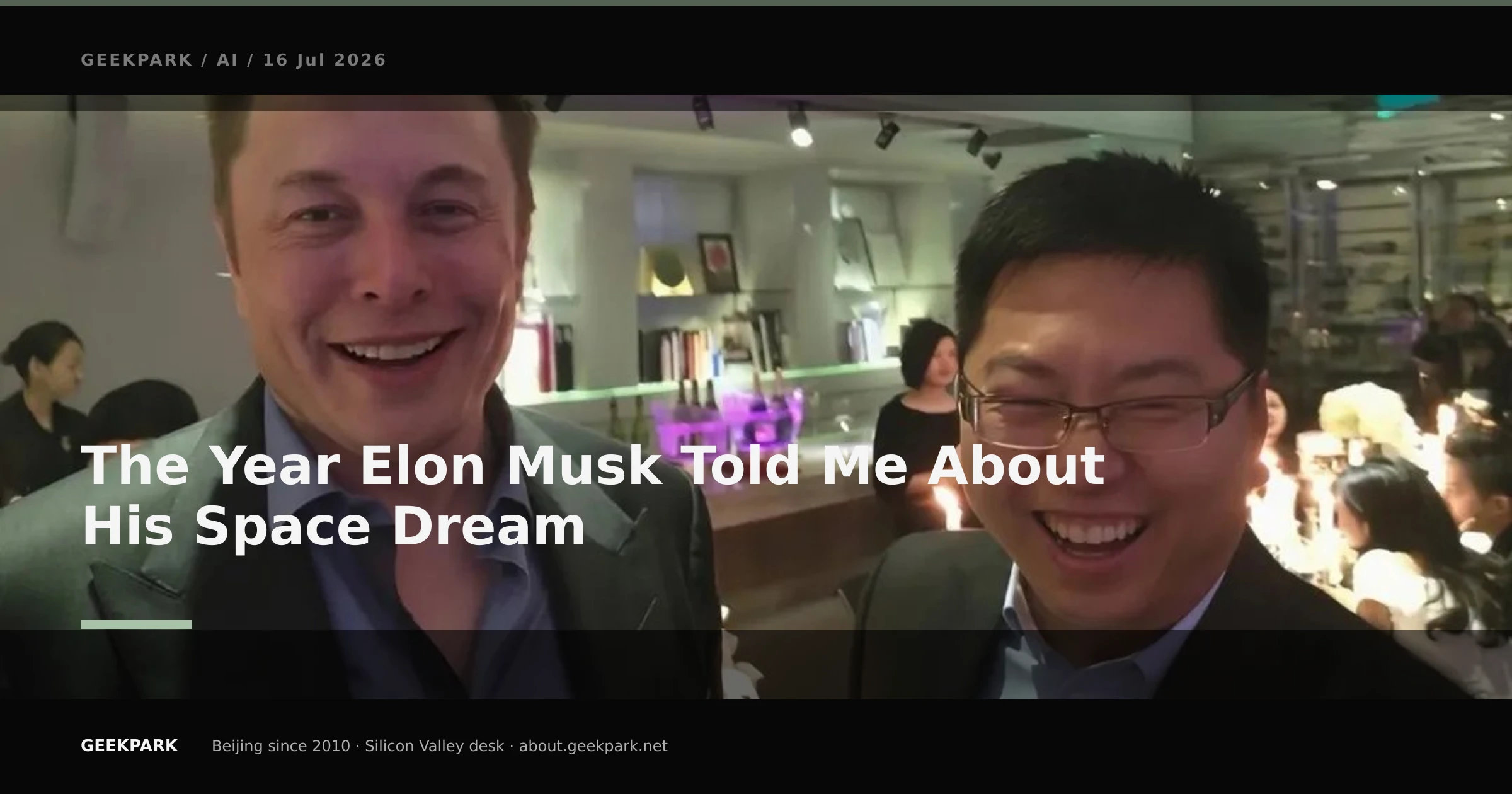
"Five hundred light-years." @elonmusk and I said it at almost exactly the same moment, and then we both laughed. I have no idea what was going through his head. I was laughing because I had just realized that almost no one else in that room cared about the number at all.
The number was about Kepler-186f, at the time the most Earth-like exoplanet anyone had found, about 500 light-years away. Zhang Yaqin was sitting next to me at dinner, talking with Musk about when humans might actually reach Mars, and he mentioned in passing that NASA had just found a twin Earth "around 600 light-years out." Musk corrected him before I could, almost without thinking: "Five hundred."
The NASA announcement was only days old. Musk had already filed it away as common knowledge. That was one of the moments his eyes lit up the brightest on his first public day in China.
He had earned the right to be tired. He flew into Beijing that morning on a private jet, went straight to Tesla's Beijing office, came to GeekPark's Singularity conference, sat through a brutal two-and-a-half-hour interview with CCTV, took business meetings until half past six, and then showed up at our welcome dinner. When I finally saw him he was still full of energy. You have to respect that. The man runs two of the coolest companies on the planet and clearly has a different kind of fuel in him.
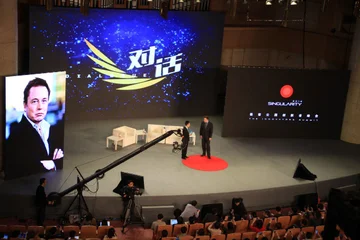
Elon Musk at GeekPark's Singularity 2014 (The Innovators Summit), Beijing
Musk is not a schmoozer and not a man who enjoys working a room. He has said it himself: he is more like a slightly crazy engineer. Do not expect him to read the crowd and flatter people the way polished business types do. Ask him something that bores him, or something so off the wall he can't answer it, and he goes flat. The interface closes. Ask him the right question and you can watch the excitement move into his eyes and his whole body.
He also knows he has to repeat the same things to different people, over and over, and that sometimes he has to crouch down to meet a different audience where they are. So if you are meeting him for the first time, and you ask him something he has already answered a hundred times, something you could have found with a search engine, he will patiently say it again. This is not because he is kind, and not because he is protecting some commercial interest. It comes from an extremely strong sense of self: he thinks most people simply have not seen the right direction yet, that they need to be led, and he does not mind pointing the way for someone who is lost.
Stay lost on purpose, though, and he will hand you a cold face without a second thought. Sometimes the only thing you get is the back of him walking away.
What follows came out of the gaps: the warm-up before he went on stage at Singularity, the waiting, the walk out, and the dinner where I sat beside him. Some of the questions came through other guests I was helping translate. Because I was mostly grabbing moments wherever I could, the questions are not a tidy system, and I am working from memory, so some of the wording may be off. But I think you will still feel how this man thinks.
I asked him why he kept going with Tesla when he himself had said it would probably fail.
Someone has to push the industry to think inside a new framework, he said. He had expected, even believed, that the legacy car industry would grow an electric future on its own. It couldn't. So he decided Tesla had to build the new framework and show everyone there was another way. "It succeeding is my good luck," he said. "What I actually want is for the whole industry to change." He pointed out that Tesla was already licensing its technology to other carmakers. He was not trying to replace them. He wanted them on the right road.
I asked why he was so committed to solar superchargers.
Cost is the most important factor, he said, but in a market like China, cutting the energy lost converting coal into electricity matters a great deal too. Then he told me about a joke going around California that he clearly enjoyed: if the world ends like it does in the movies, you can still drive your Tesla, because nobody will be pumping gasoline anymore and it will run dry, but a supercharger running on sunlight keeps going for a long time. He said it as a joke. I thought the logic fit him better than he let on. I said he hadn't mentioned what I considered one of the Model S's biggest advantages over a normal car: that it can update itself remotely and keep getting better. We love that feature.
He doesn't like talking about individual features, he said, because to him Tesla is a systemic innovation, not a single selling point. But yes, you can update the car over the air whenever you want, and it becomes a better, more useful machine, more suited to you. Every detail about driving and handling that we can already see, and everything we are about to see, can be optimized and solved faster once that mechanism exists.
I asked whether he worried about the security of that cloud-plus-car architecture.
What I described was only theoretically possible, he said. No one has ever pulled it off. Not one example. They had anticipated it and run plenty of tests and found no exploit. "Honestly, I don't understand why you think anyone would do this."
He was about to go cold. From what I could tell, he treated worries about battery safety the same way: taking a low-probability event and using it to slow the big direction struck him as bad-faith nitpicking, not constructive. It has always been his style. His aggressive approach to Tesla's autonomy has been argued about in the car world for years. The Dragon capsule that just launched is another example. At the design stage he wanted rocket-controlled recovery, the Falcon 9 way. NASA flatly refused, too risky, and he compromised back to an ocean splashdown. Whether he ever truly agreed, I have no idea.
I asked why he was CEO of two companies.
"I didn't want to be a CEO at all," he said. What he really wanted was to be an engineer who could design and build products his own way. He had tried twice to bring in a CEO to run a company for him. It didn't work. He realized that if he wasn't personally in it, things went badly wrong. And obviously, if you want to do the one thing only you truly believe in, it is hard to find a stranger to make it real.
I asked why he was so set on something as risky as SpaceX.
He loved science fiction as a kid, he said, and had always thought exploring space was an extraordinarily interesting and meaningful thing to do. "I'm not building rockets because I want to go to space myself. Getting myself up there is easy." (The confidence.) But if ordinary people can't reach space, humanity stays locked on Earth, unable to explore the universe, unable to become a civilization based on more than one planet. We have to believe this is the right direction, he said, because if we can't do it, our civilization is fragile.
We have to drive the cost of reaching space down hard, he went on, and the real path is not waiting for some sci-fi technology to fall from the sky. It is taking mature rocket technology and making it reusable. He put the cost reduction at 100x, at least. "Don't you think that's worth doing?"
I said both of his companies had nearly failed and that he had put his entire fortune on the line for each, and that a lot of people probably can't understand his thinking.
"That's why I said these things are hard to get other people to do for me. I can only do them myself. I've said I might not succeed. But someone has to step up and start."
I asked if he had ever thought about going into politics. If he became president, wouldn't he be able to push his goals on the environment and space exploration even faster?
He hadn't thought about it, he said, and he didn't think he would. What he can push is a good direction through products and technology, not laws that bend the world into the shape he wants. Take the Tesla, he said. He wants you to choose it not only because going electric is a responsible thing to do for the future, but because it is genuinely a good product, which is the real reason you would choose it. He did not think being president would solve that problem. He is better suited to being an engineer and a designer.
I asked how on earth he had convinced NASA and the US government to let him get into the rocket business.
He won the trust step by step, he said. He had spent his own money on research the agencies wouldn't touch. They saw how much he had spent, how serious and committed he was, that there were results, and only then did they give him a chance to try more. He thought this was a perfectly normal process. The main thing in persuading people is not lobbying, he said. You have to actually believe in the thing, and carry it to a tipping point where everyone can see the hope.
I asked the obvious follow-up: why had SpaceX managed to bring launch costs down when NASA, with all its experts and resources, had not?
"I think the real reason NASA couldn't," he said, "is precisely that they have too many resources."
I asked what he thought of the companies offering suborbital tourist flights.
He shrugged, shook his head, and declined to answer. The closest word I have for it is a scoff. He had no interest in serving recreational demand. It does nothing for the goal of carrying humanity toward a multiplanet civilization.
Now that you have read all that, it is worth coming back to what the successful launch of a crewed commercial spacecraft actually means.
To me this was not a simple commercial rocket going up. It means commercial spaceflight has matured to the point where it can carry people, a crown-jewel mission. The space age began in the 1950s, but its starting gun was fired by competition between governments. After the US won the race to the Moon, science-driven spaceflight kept producing steadily, and yet it stayed a government program. The technology kept advancing, but to this day landing on the Moon remains humanity's highest achievement in space.
The significance of commercial spaceflight is that space exploration stops being a line item in a government budget and becomes an industry, one that can pull in more minds and more capital and build a positive loop of value creation. That story has already played out, again and again, in aviation, in telecommunications, in computing.
Only this way do you escape the paradox Musk named: too many resources, so no progress. Commerce, by its nature, has to chase efficiency and progress, and that has to come through innovation, standardization, and scale.
Commercial spaceflight is what will truly open a space age that belongs to all of humanity. You could even call it the opening of a new chapter, the moment we go from being able to touch space to actually being willing to walk toward a multiplanet civilization. Commerce is the force behind that, stronger even than curiosity, the hormone that finally lets humanity take a big step forward. Six years ago I asked Musk whether I would live to see ordinary people able to afford a trip to space. He was completely sure. "We definitely will."
It will also be a hard road. Just before this successful launch, the Starship rocket, still in early testing, blew up in an experiment. That vehicle is meant to carry 100 people to space at a time. If the Falcon 9 and Crew Dragon pairing is a small ferry skiff to space, Musk is clearly already drawing the real ferry in his head. He wants a million people living on Mars by 2050, before he turns 80. The idea sounds insane to most people. He clearly has a roadmap and a timetable, and he is running on it.
I don't think Musk will be the only person who matters in opening the real space age. He is the rider out front, breaking the wind, taking the hardest resistance head on so the rest of the pack can ride faster. More capital and more capable people will join this industry. And a new generation of space engineers in China has the same chance to become a force that carries humanity forward.
I hope the dream so many of us share, of going to space once in this lifetime, comes within reach because of this industry, and comes soon.
Good luck, Musk. Good luck to everyone in this business. And good luck to us.