Brad Yuan believes entertainment can solve one of AI's hardest data problems: teaching models what happens when humans interact with the world. His bet starts with an AI companion app. The bigger question is how far its data can take him.
Midway through our conversation, Brad Yuan turned his product on and let a character sing to him.
It sang differently than the last time, because nothing was pre-rendered. He tilted his head, and the character responded to his expression. He handed it a flower, and it took the flower.
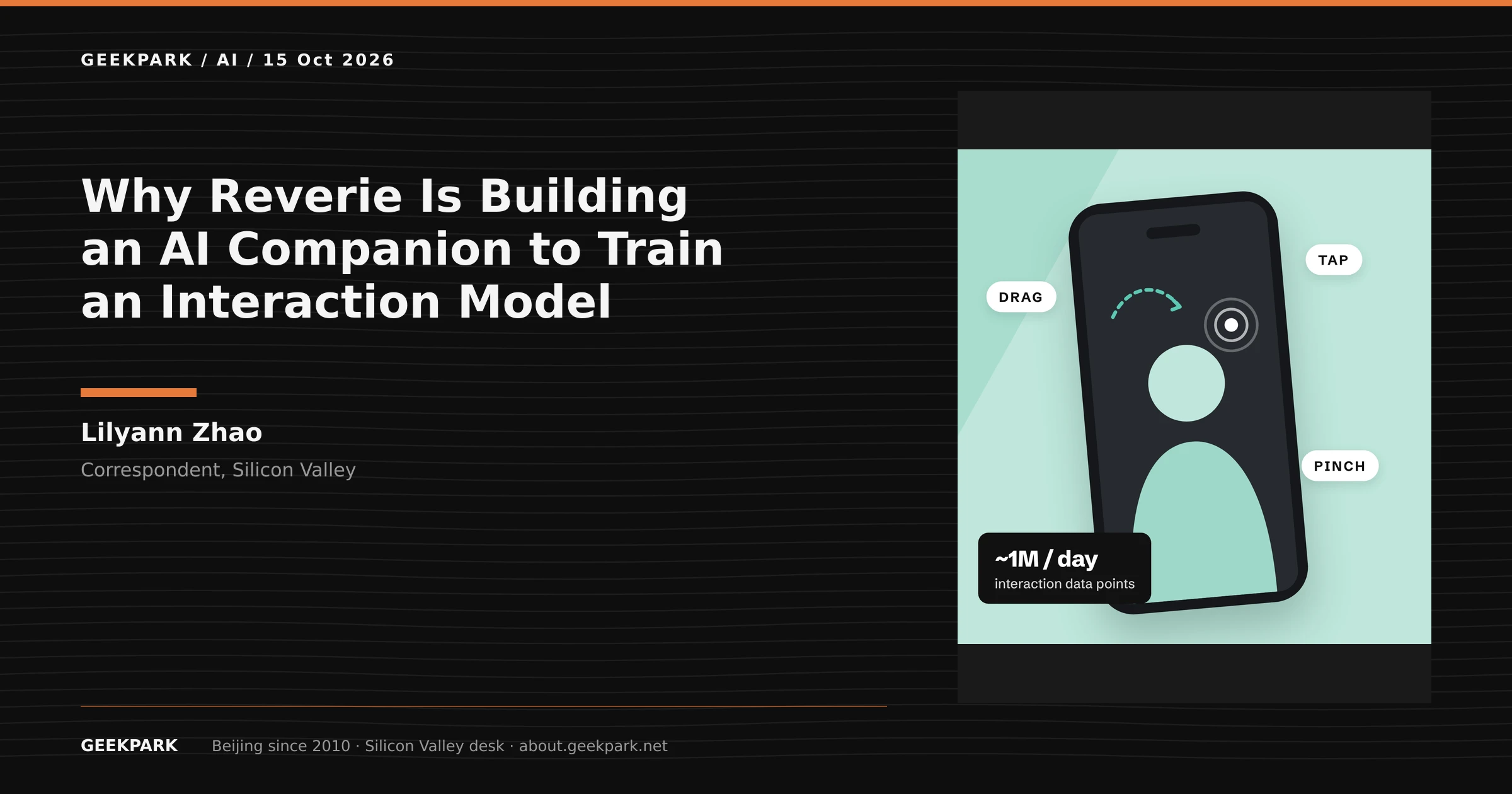
On screen, you can tap a character, drag it, or pinch something out of its hands. The video regenerates around whatever you do, continuously, in real time.
There is no predefined gesture library, and that is deliberate.
"If you predefine a fixed gesture library," Yuan says, "the product degrades into a traditional effects tool."
The product is called PopVid, built by Reverie. It launched on the web in March and, according to the company, has attracted 50,000 to 60,000 daily active users. Sessions can last tens of minutes. Users generate roughly a million interaction data points a day, each capturing an input and the model's response. The company says it has accumulated around 100,000 hours of human-video interaction.
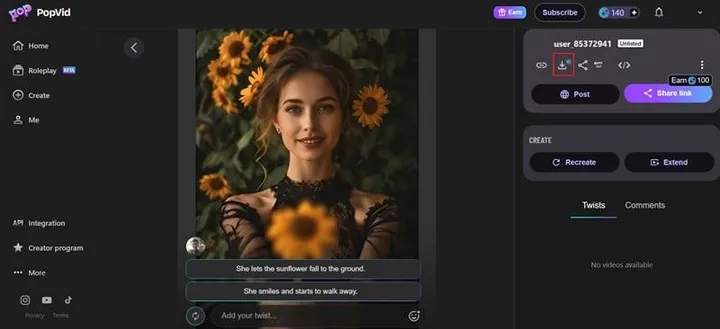
PopVid generates video responses in real time as users interact with AI characters. Credit: Reverie.
Yuan describes his longer-term ambition as an AI version of TikTok: a user-generated content platform that requires less creation and invites far more interaction.
Today, the product looks closer to an AI companion. Yuan says appearance is often what attracts users initially, while evolving storylines keep them engaged. He sees audiences already familiar with Character.AI, Chai, and PolyBuzz as a natural starting point for a more visual, interactive experience.
But Yuan is not trying to build another companion app as an end in itself.
He wants to build a foundation model capable of understanding and responding to human interaction in real time. The companion app is his way of getting there.
That distinction is the central bet behind Reverie — and one of the most interesting questions in an emerging category that has yet to agree on its own name.
Everyone Is Building Interactive AI. Few Agree on What It Is.
Yuan calls his technology an interaction model.
Loopit describes its approach as an interactive world model. SigmaZ AI, which generates executable visual code rather than pixels, positions its technology as the next generation of AI interface. Runway has introduced Characters, GWM Worlds, and Solaris, while Vidu has separated its S-series into what it calls Real-Time Generation Models.
The labels differ because the companies are approaching a similar opportunity from very different technical directions.
Two developments helped make this possible.
First, diffusion-based video generation has become significantly faster. What once required generating a complete video clip before viewing it can increasingly be performed continuously, with new frames responding to incoming user input.
Second, coding models have become capable of generating increasingly sophisticated interactive interfaces and playable environments from natural-language instructions.
Together, these advances have changed what "real-time" means for generative AI.
It is no longer enough to produce a video quickly. The system must respond while the experience is still unfolding, preserve what has already happened, and adapt to what the user does next.
Speed is the entry fee. The interaction loop is the product.
The most useful way to distinguish these companies is to ask a deceptively simple question:
When a user does something, what remembers the consequence?
SigmaZ makes state explicit through executable visual code, which a browser renders deterministically. Charts, buttons, and 3D objects remain interactive because they exist as editable objects rather than merely as pixels. The approach lends itself to productivity and educational interfaces, though it depends on generating reliable code and visually convincing experiences.
Loopit divides the problem between two systems. A coding model maintains rules, world state, and long-term memory, while a real-time video model renders the visual experience. Users see generated video, but a computable representation of the world sits underneath it.
Runway's Solaris takes a different route, relying on the generative model to maintain visual consistency and state directly in pixel space, without an intermediate code representation.

Runway's Solaris generates interactive interfaces frame by frame, responding directly to user actions. Credit: Runway.
Reverie's approach is closer to the latter. It generates native audio and video without relying on an underlying code layer or explicit scene graph.
That architecture offers greater freedom in visual expression and open-ended interaction. It also places substantial demands on the model: latency, generation costs, visual consistency, and multimodal understanding must all be managed within a continuous experience.
The trade-off is fundamental. Explicit structure makes a system easier to control, but can constrain what it generates. A more fully generative approach offers flexibility, while making consistency and control harder to guarantee.
Yuan believes the starting modality matters.
His comparison is with Thinking Machines Lab's interaction model, which combines video, audio, and text inputs with audio and text outputs.
"They put much more emphasis on the text modality," he says.
Reverie, by contrast, is designed around generating video as the primary output. Users do not simply communicate with a model that can see. They interact with a visual environment that changes in response.
The distinction is meaningful, although these systems are not direct equivalents. Thinking Machines' model also generates audio, and the architectures serve different intended experiences.
What remains unresolved is which approach will generalize most effectively as interactive AI moves beyond demonstrations into everyday products.
For Yuan, that question begins with a different problem: where to find the data to train such a model.
Why Entertainment? A Two-Axis Theory of AI Deployment
Before founding Reverie, Yuan worked on robotics at Google X.
His experience informs a framework he uses to explain why he chose entertainment rather than robotics as the starting point for an interaction model.
He places AI applications along two dimensions: the cost of acquiring real-world data, and the cost of failure when the system makes a mistake.
Robotics and many applications in medicine or agriculture face substantial data-collection costs. Autonomous driving can collect large amounts of data during normal operation, but failures can carry severe consequences. Robotics can face both challenges simultaneously: expensive data and high-stakes deployment.
Consumer entertainment operates under different conditions.
People interact voluntarily, generating feedback through ordinary use. And when a character responds incorrectly or a generated scene breaks down, the consequences are generally much smaller than those of a physical-world mistake.
"Our judgment is that this is the first place a technology this immature can actually land," Yuan says.
The argument helps explain a broader tension in AI development.
Some of the applications with the greatest potential impact are also the hardest environments in which to deploy an imperfect model. The cost of a mistake can limit how frequently a system is tested with real users, slowing the accumulation of the very data needed to improve it.
Entertainment offers a lower-stakes environment for experimentation.
A consumer application can expose an immature model to a wide range of human behaviors, collect reactions, and improve through repeated interactions.
But entertainment is not automatically an inexpensive source of training data. Generating real-time video consumes compute, and acquiring and retaining users has its own costs.
This is where Reverie's strategy becomes more interesting.
Yuan is not merely using entertainment to demonstrate a model. He is trying to create a consumer product whose everyday usage produces training data that would otherwise be difficult to collect.
The model improves the product. The product attracts users. Those users interact with the model, producing more data for the next generation.
At least, that is the flywheel Reverie hopes to build.
The Data Flywheel: Cheap Interaction Is Not Free Interaction
The distinction between video data and interaction data matters.
A conventional video dataset contains sequences of frames. An interaction dataset needs something more: the context of an experience, a human action, the system's response, and the subsequent actions conditioned on what happened before.
It captures not only what changes on screen, but what caused the change.
That kind of data is much harder to find at scale.
Video games offer one potential source because they contain structured environments and human actions. But game data is not necessarily collected or stored in a form suitable for training general interaction models.
A record of keyboard commands in a particular game, for example, may not capture the broader intent behind an action or how that intent transfers to a different environment.
Yuan is skeptical that existing game datasets can provide the full range of behaviors he wants a model to learn.
His alternative is to generate interaction data through a product built around human participation.
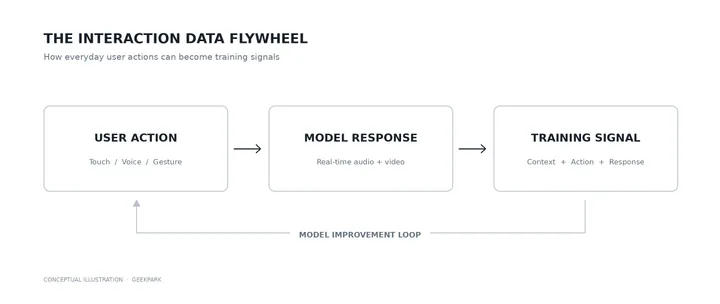
PopVid turns ordinary user behavior into sequences of actions and responses. A person moves a character, interrupts a scene, changes an interaction, or expresses something through the camera. The system responds, and the resulting sequence can become part of the company's data pipeline.
The ambition is straightforward. The economics are more complicated.
Every real-time generation requires inference compute. Unlike passive collection of some existing real-world activity, Reverie has to generate much of the visual experience that produces its interaction data.
Public benchmarks for real-time diffusion video can imply substantial costs when extrapolated across long periods of generated output.
Reverie says its inference economics are already very different from those public baselines. According to the team, its current serving stack is roughly 100 times more cost-efficient, with a third-generation model expected to deliver a further two- to threefold improvement.
That would substantially change the economics of gathering interaction data. But the total cost depends on how much video is actually generated, at what quality and utilization, rather than simply how long users spend interacting with the product.
And inference is only one part of the equation. Training, infrastructure, user acquisition, and retention also determine the cost of building the data flywheel.
The deeper advantage of entertainment is therefore not that interaction data is free. It is that a successful product can turn an ongoing user experience into a recurring source of training signals.
In entertainment, cheap data isn't the reason you get to play. It's the prize for winning.
Yuan estimates that pretraining a substantially more capable interaction model could eventually require something on the order of 100 million hours of data — roughly a thousand times Reverie's reported current scale.
It is an ambitious target, particularly for a young company competing for attention in an already crowded consumer AI market.
Reaching that scale would require much more than making inference cheaper. It would require a product people return to consistently, and a reason for them to continue interacting even as alternatives proliferate.
Which makes retention, rather than generation speed alone, a crucial part of the strategy.
A Retention Problem, or a Category Problem?
One of Yuan's most useful observations comes from how he interprets the company's retention data.
He distinguishes between users who abandon the product shortly after trying it and those who continue returning after the initial experience.
What interests him is not simply how many users remain at a given point, but how retention changes over time.
Reverie has seen meaningful early drop-off, while the users who move past that initial experience show stronger persistence.
Yuan's interpretation is that at least some of the early churn reflects a mismatch between user expectations and the product itself.
People may arrive expecting a conventional video-calling application, only to discover an experience that does not fit neatly into any familiar category.
Some leave because the product is not what they expected. Others discover its interactive storytelling and companion features and find reasons to return.
This suggests a distinction that matters well beyond Reverie: a weak first-day experience can reflect an acquisition or positioning problem, not necessarily a lack of underlying product value.
Of course, the two are not mutually exclusive. Retention alone cannot establish whether users leave because of misleading expectations, product friction, or limited interest. That requires deeper analysis of how different cohorts arrive, behave, and return.
For Yuan, though, the challenge of naming the product is immediate.
There still isn't a simple phrase that tells the public what PopVid is or why they should try it.
Call it an AI companion, and people think of Character.AI. Call it interactive video, and they imagine a different kind of creative tool. Call it an interaction model, and the description becomes technically more precise but less intuitive to an ordinary consumer.
This is a problem for a product seeking mass adoption. It is also characteristic of a category whose conventions are still being invented.
Reverie has to discover not only what people want to do with interactive AI, but how to explain the experience before they try it.
Yuan's current answer is to begin with a recognizable consumer desire: interacting with an attractive, responsive character whose story continues to evolve.
The question is whether that starting point can support the much broader platform he wants to build.
Can Companion Data Train a General Interaction Model?
A successful data flywheel is not necessarily a generalizable one.
This is the harder question in Reverie's strategy.
PopVid's initial audience skews young and male. Its current engagement is driven significantly by character appearance, companionship, and evolving storylines.
These interactions can provide valuable signals about what users want from AI characters and how they respond to dynamic visual experiences.
But a model trained on this behavior may become particularly good at precisely those experiences.
That does not automatically mean it will learn the broader understanding required for interactive games, educational applications, productivity software, or eventually embodied environments.
The issue is not unique to Reverie. It is a challenge for any company hoping to turn data from a specialized consumer application into general-purpose model capabilities.
What transfers from one environment to another?
A model that learns to respond to a user's facial expression during a fictional conversation may develop capabilities useful in other forms of interaction. But the extent of that transfer remains an empirical question.
Yuan makes a related criticism of game data: because it is shaped by designed environments and predefined rules, a model trained on it may inherit those constraints.
The same question can be asked of Reverie's own data.
If the training distribution is dominated by companion-style interaction, how much of what the model learns will extend beyond companionship?
Other companies are approaching this challenge from different directions.
General Intuition is betting on game-derived interaction data as a foundation for broader intelligence. Loopit has built a consumer platform around interactive experiences, accumulating a large library of user-created works and engagement patterns.
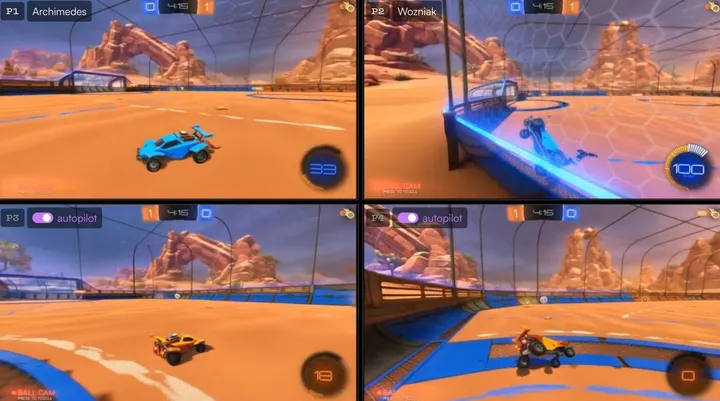
General Intuition's MIRA explores how models can learn interactive world dynamics from gameplay data. Credit: General Intuition.
Loopit's team has been careful to distinguish between understanding what users want to create and having data that can directly train a general world model.
That distinction matters. A large collection of user activity is not automatically a high-quality training dataset. The representation, coverage, and diversity of interactions may matter as much as the volume.
Competition is also emerging at the infrastructure level.
Runway offers Characters as an API through which developers can define character behavior and connect external systems. Vidu's real-time generation technology can also serve as a component within broader applications.
Reverie is exploring that route as well. Developers are already experimenting with its real-time interaction API, building prototypes such as an AI news anchor, a multiplayer Werewolf game with AI participants, and an interactive adventure.
Those experiments point toward a future in which an interaction model could serve many different applications rather than a single consumer destination.
They also create a strategic question. If real-time interactive generation becomes an infrastructure layer available to any developer, how much of the resulting value will belong to the model provider, and how much to the applications that own the user relationship?
Reverie is already seeing early experiments beyond its own companion app. Developers are using coding agents and Reverie's real-time interaction API to prototype different experiences: a 24-hour AI news anchor, an online Werewolf game featuring five AI players and one human participant, and an interactive adventure game.
What makes these examples interesting is how little application-specific development they appear to require. Developers can describe an experience in natural language, use coding agents to assemble the application, and connect Reverie's API to handle real-time audiovisual interaction.
These are still early prototypes, not evidence of broad developer adoption. But they offer a glimpse of a different role for Reverie's technology: not just powering its own consumer app, but becoming an interaction layer that other applications can build upon.
For Reverie, owning both a consumer product and the underlying model could provide an advantage. The product offers direct feedback, while the model can potentially support entirely different experiences.
Whether those two businesses reinforce one another will depend on what the company can learn from the data its product generates.
As AI companions become increasingly visual and responsive, the industry will also face questions around content safety, age-appropriate experiences, camera data, and privacy. These are not unique to Reverie, but they will become part of building trust as the category matures.
The immediate technical challenge remains more fundamental: demonstrating that interaction data collected in one kind of experience can meaningfully improve a model's capabilities elsewhere.
From Watching Content to Changing It
For years, consumer platforms have focused on deciding which content to show each user.
Recommendation systems learned to predict preferences, rank videos, and personalize feeds. The content itself generally remained fixed.
Interaction models propose a different relationship.
Instead of choosing among finished videos, users can influence what happens inside the experience. A character responds to a gesture. A story changes direction after an interruption. A visual environment adapts while the user is still participating.
The output is no longer simply consumed. It is continuously shaped through interaction.
That creates a different kind of data.
Each session can capture not only what someone chooses to watch, but what they choose to change: which characters they approach, when they interrupt, how they respond, and what makes them continue.
In the near term, those signals can help improve a consumer product.
In the longer term, Yuan believes they could become the foundation for models that understand human interaction in a more general way.
That is the version of the future in which 100 million hours of interaction data becomes worth pursuing.
For now, Reverie has a consumer product attracting early users, a model architecture built around native real-time generation, and a thesis about how the two can reinforce one another.
What it does not yet have is proof that the resulting data can support the general-purpose capabilities it ultimately wants to build.
That leaves the central question open.
Can millions of small, everyday interactions teach a model something general about how humans act and respond? Or will they mostly make it better at the experience that produced them?
Yuan is betting on the former.
The answer will depend not only on how much interaction data Reverie collects, but on what its models can learn from it.
Reporting by GeekPark. Interview by Wanhu and Lilyann.