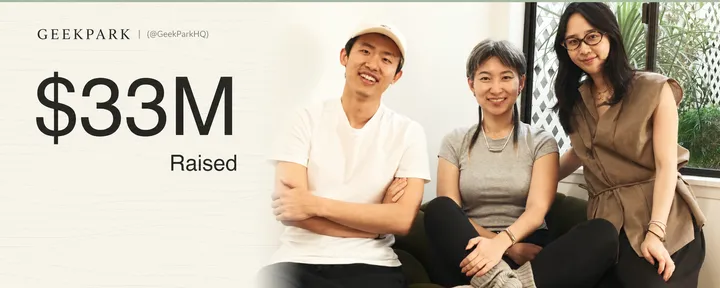
Nirva, the San Francisco startup making AI-powered jewelry, today announced a $25 million pre-Series A round, bringing its total funding to $33 million following an $8 million seed. The company is backed by Lightspeed Venture Partners, South Park Commons and others. Orders open in November at an expected price of around $249, and the first pieces ship by the end of 2026. More than 9,000 people are already on the waitlist.
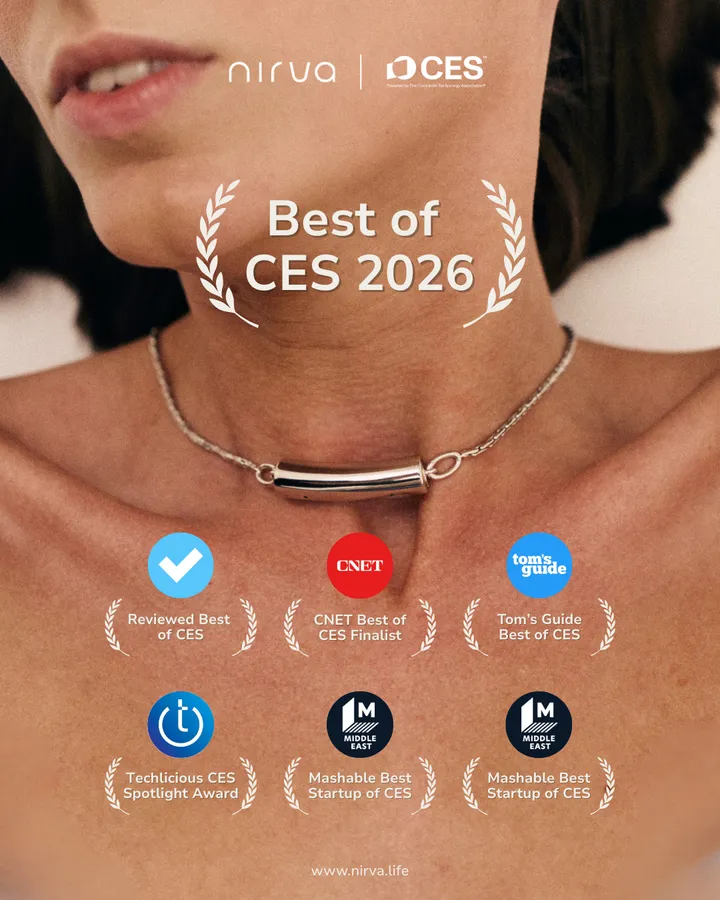
The raise caps a fast first year. At CES 2026, its first public outing, Nirva stood out on a show floor packed with gadgets: its booth looked more like a jewelry presentation at fashion week than a tech demo. Executives from Microsoft, Amazon and Meta stopped by, and CNET named Nirva to its Best of CES list, one of three startups selected from more than 1,000 exhibitors. The new funding takes the company through launch and into its next generations of hardware. The team of roughly 20 is hiring engineers to build personal AI, along with product designers and marketers, in San Francisco.
Last month, GeekPark sat down with co-founder and CEO Wei Lyu for an in-depth conversation about how Nirva got here, and where it goes next.
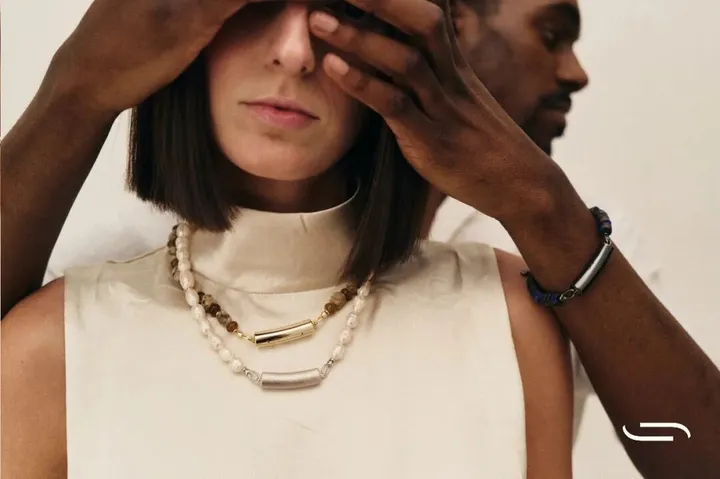
Nirva's first piece weighs under eight grams and can be worn as a necklace or wrapped around the wrist as a bracelet. It's built for all-day wear, gets two to three days of battery life, and is designed to recognize and focus on the wearer's own voice. Nirva doesn't take meeting notes, and productivity isn't the point. Instead, it builds long-term context to understand a person's emotions, relationships and behavioral patterns, helps them journal their life, and proactively checks in or offers suggestions when the moment is right.

That product sits squarely at the intersection of Lyu's last ten years. After graduating from Peking University, she co-founded a Y Combinator-backed AR startup, then built AR glasses at XREAL, and went on to spend four and a half years at Meta working on Ray-Ban Meta and Oculus Quest. During her first startup, she also studied fashion design at Parsons. Wearables and fashion, two threads that rarely meet, finally converge at Nirva.
Lyu's co-founders round out the team. CTO Jason Chen was an engineering manager at Facebook and Meta Reality Labs, where he built core technical infrastructure for consumer products serving billions of users. Chief Creative Officer Hanying Hu leads fashion and design; she founded the jewelry and fashion brand HANYING and has designed accessories for artists including Lady Gaga and BLACKPINK.
Why does journaling your life need dedicated AI hardware? What makes a device something people will wear every single day? Hardware gets cloned fast, and frontier labs keep pushing into vertical use cases, so what kind of moat can a startup actually build? For Lyu, all of these questions come back to one thing: what irreplaceable value Nirva delivers to its users.
"At the end of the day, we're not selling a hardware device," she says. "We're selling self-understanding and self-improvement."
This conversation has been edited for length and clarity.
01 | A decade in wearables, and a clear entry point for the first AI-native device
GeekPark: Why Nirva? How does it connect to what you've done before?
Wei Lyu: Nirva ties together a few of the things I care about most in my life.
The first is wearables. Since I graduated in 2016, I've spent ten years working on AR glasses and wearable devices. From very early on, I wanted to help define the next personal device, the next computing platform and the next way humans interact with machines. I've never thought the phone was the ideal form factor, and I've always believed another major platform is coming. After school, I started a YC-backed AR company, then built AR glasses at XREAL, then worked on Ray-Ban Meta and Oculus Quest at Meta. It's basically been one continuous line.
The second is fashion. I studied film as an undergrad and arts management in grad school, and I interned at Christie's. During my first startup, I also took fashion design courses at Parsons. That's when I realized the fashion industry and the tech industry think about products and strategy in completely different ways. I started to believe that genuinely bringing fashion and wearables together would be something special. A lot of companies have tried and failed, and a big reason is that their founding teams didn't have fashion in their DNA. In many ways, the fashion mindset and the tech mindset pull in opposite directions.
The third is my own life goal. I want to keep growing my self-awareness. I may never reach anything like "enlightenment," but I think the journey is more romantic than the destination. So much of personal growth comes from reflection, and how well you understand yourself shapes how wise you can become.
The name Nirva comes from nirvana, a Sanskrit word for the highest spiritual state a person can reach. Our founding conviction is that wearables and AI can help people understand themselves better and become better versions of themselves. Fundamentally, we're not selling a hardware device. We're selling self-understanding and self-improvement.
I've started a company before. Once you've been through it, you realize a lot of things, fundraising included, are just noise. The real question is: if something is going to take ten or twenty years, are you willing to spend the most valuable years of your life on it? Nirva is my answer to that question.
GeekPark: Why now?
Lyu: Meta was my only big-tech job, and I was there for four and a half years. I never planned to stay long-term. I went because Meta was investing more than anyone in next-generation computing devices. I wanted to understand the frontier technology, wait until the direction was clearer, and then go build my own thing. I also believe that the longer you stay at a big company, the more you get trained to focus on one narrow slice of a problem and lose sight of the whole system.
I left to start Nirva last year for two reasons. First, model capabilities had finally reached the point where they could support a lot of AI-native experiences. Many of Nirva's proactive, AI-native features exist only because models got better. Second, I'd spent years thinking about which use case and which audience the first AI-native device should target. By last year, that answer had become very clear and very concrete.
GeekPark: So how did you land on the entry point for your first product?
Lyu: At Meta, we explored pretty much every wearable form factor you can imagine and built a ton of prototypes. Nobody is confused about what the end state looks like. What the industry is really struggling with is how to get there.
Big companies like Meta and Apple move slowly partly because they aren't interested in narrower, vertical markets. They want to build a general-purpose computing device right out of the gate, one that solves ten problems for a very broad audience. But hardware and software still have real limitations today, and that approach usually means none of those ten use cases is good enough.
I used a few filters for the first product. One: the hardware and software have to be buildable today. Two: it can't just be two or three times better than what exists; ideally, it's something a phone or any other existing device fundamentally can't do. Three: the people who want it most need to have both the ability and the willingness to pay. Four: it has to stay on the long-term path toward the next computing platform, the ultimate AI-native personal device, rather than being a detour.
Where we landed was life journaling and everyday companionship. Nirva is a fashion accessory you wear all day, designed to focus on the wearer's own voice. It continuously learns from how you express yourself, picking up on your thoughts, feelings, emotions, communication style and needs, and helps you journal your life with very little friction. The AI can also check in with you at the right moment, offer suggestions and even take care of things for you.
02 | AI can only truly understand a person with all-day context
GeekPark: How do you pitch Nirva to users?
Lyu: Our one-liner is: Nirva journals your life and is your best companion ever. It helps you capture your life, and it acts as an everyday companion or life coach.
The app has a few core experiences. The first is Journaling, which helps you record your life. The second is Insights, which uses long-term context to surface patterns in how you think, feel, communicate and relate to people. The third is talking to Nirva directly, where you can get highly personalized advice about anything. Nirva is also proactive: when it picks up that something important has happened in your life, it reaches out to you.
A lot of people's first question is, "So is this another voice recorder?" We tell them clearly: we don't do meeting notes, we're not a productivity tool, and Nirva isn't built to record the people around you. It's a life companion designed for self-understanding and self-improvement.
In the U.S., most of the demand for meeting notes is already covered by Zoom, Google, Slack and other workplace software. For white-collar workers, buying a separate piece of hardware just for meeting notes is a much smaller market than people assume.
GeekPark: Why would anyone need a device they wear all day?
Lyu: A lot of today's so-called AI devices are still session-based. They get to know you for a few seconds or a few dozen seconds at a time, so the context they capture is very limited. The amount of context directly determines how deeply AI can understand you, and how proactive it can be. All-day sensing is the prerequisite for AI to really know you and develop proactive intelligence.
There are about 340 million people in the U.S., and roughly 150 million of them have downloaded or tried a journaling app. But five out of six give up within the first two weeks or the first month. In our user interviews, almost everyone had tried journaling at some point in their lives and quit because the friction was too high. That tells you people do want to record, revisit and reflect on their lives. The problem is that existing solutions demand a lot of discipline.
An AI accessory that's with you all day has already captured a lot of the relevant moments. It can do part of the journaling for you, then nudge you at the right time, turning journaling into something low-friction and actually fun.
Ask a lot of busy city people what they did last week or last month, and they often can't tell you. That feeling of drifting through life on autopilot is an incredibly common modern struggle. Even just capturing your life, your thoughts and your emotions is hugely valuable, and it's very hard to do without an all-day wearable.
GeekPark: So you're targeting people who already journal?
Lyu: The U.S. has a mental wellness market worth more than $100 billion, and about 80% of it has nothing to do with treating illness. It's mostly people tending to their inner state day to day. Common products include journaling, mood tracking, mindfulness and meditation, habit building and companion apps, and they have huge user bases. But none of them knows anything about what you actually went through today, so maybe one in ten things they say really lands. Nirva can do far better than these products today, because its care and advice are grounded in your real life, which makes them much more relevant.
The U.S. also has a big life coaching market, which is one of the starkest differences between the U.S. and China. Life coaching barely exists in China, but the American middle class is very familiar with it. Around 40% of people have worked with a human life coach, and a single one-hour session can cost $200, more than a full year of a Nirva subscription.
If you go back to people's most fundamental needs, everyone wants to preserve their memories, to be cared for and understood, and to have someone help them when they don't know what to do. Those needs are universal, and they've never been well served. That's the opportunity we saw.
GeekPark: Beyond audio, where else does Nirva get context?
Lyu: With the user's permission, Nirva can draw on location, calendar, email and Apple Health data from their phone. If they already use a Whoop or an Oura, it can also pull in heart rate and other biometric data.
Long term, we want this context layer to be open. Users should be able to import information from elsewhere so Nirva knows something about them from day one, and they should be able to share the context Nirva has built up with other apps they use. Nirva has a shot at becoming a personal context hub.
GeekPark: How are you validating product-market fit? Are you seeing positive signals?
Lyu: Back then, before launch, we had a waitlist of more than 3,000 people, almost entirely organic, plus a group of beta testers. [Editor's note: Nirva says its waitlist has since grown to more than 9,000.]
The early usage data shows some very positive signals. First, people really do wear it all day. It's under eight grams, so once it's on you barely notice it, which means the context it captures over a day is fairly complete and rich.
Second, users spend several times longer in the Nirva app than in health apps like Whoop or Oura. With those, you typically just check your sleep score, which might take less than a minute. Nirva keeps generating content, including your own life, your journal entries and your conversations, so people open it multiple times a day in small pockets of free time. Nirva's home screen widget works like a little sticky note that updates based on what just happened, pulling users back in to keep the conversation going.
These are still early, pre-launch numbers, but they're giving us early signal on the product's value.
03 | Showing up proactively is the hook for building a relationship
GeekPark: Which features do users value most?
Lyu: Our core users are mostly upper-middle-income American women aged 25 to 50. Women make up about 70% of the user base, and they tend to live a fairly intentional, self-care-oriented lifestyle.
In our early research and testing, two capabilities resonated most with target users: journaling their life, and discovering their own behavioral patterns, in other words, self-awareness.
A lot of the problems people run into at work, in life and in relationships come from not understanding their own patterns. You keep thinking, acting and communicating a certain way, but you don't have a third-person view of yourself. Nirva can surface the patterns that actually show up in your behavior.
It's a bit like why people love MBTI. MBTI relies on a hundred or two hundred questions, so its understanding of you is pretty limited. If an AI listens to you for three months, or three years, it may understand you better than you understand yourself.
Awareness is where change begins. But we don't want to just hand users an analysis report; we want to help them actually make their lives better. So when it comes to being proactive, Nirva doesn't stop at giving you information. Over time, it can take on more tasks for you and help move your life forward.
Once, I was dog-sitting for a friend and accidentally closed a door on the puppy's paw. I kept asking if it was okay and pretty quickly spiraled into guilt and self-blame. I never deliberately told Nirva what had happened, but it picked up enough context. Later, it sent me a reflection pointing out how quickly I slid into self-blame.
Once Nirva understands a moment like that, it can keep helping. It knew the puppy belonged to my friend, so it drafted an apology text, looked up how to care for an injured paw and even suggested a small toy as a gift.
GeekPark: What does proactivity look like in practice?
Lyu: We offer several kinds of proactive features today, and users can configure them. One is a well-timed word of care or encouragement based on something that just happened. Another is curiosity: when you mention a topic you're interested in but didn't get around to looking up, Nirva researches it and sends you a short report. It can also spot moments worth being grateful for or worth remembering, or turn small things you mention in passing that need follow-up into reminders.
Early on, proactivity works like a hook. Say you just had a fight with your partner. If nobody asks you about it, the moment just passes. But if Nirva asks, "You seemed a little upset just now. Want to talk about it?" you'll probably keep opening up. As the relationship builds, users also get into the habit of sharing their thoughts with Nirva on their own.
The device has two modes: passive listening and direct conversation. By default, Nirva acts as an observer, understanding what you express. Press the button, and it knows that what you say next is directed at it. Both the third-person observation and your own direct expression matter. Even a friend who knows you well can't read your mind, and AI needs both kinds of information too.
GeekPark: Nirva also handles reminders. How do you keep it from turning into a productivity tool?
Lyu: The line we really want to draw is between relational products and utilitarian ones. People usually have no emotional connection to tools. No matter how many times you use a meeting notes app, you'll never say "it really gets me." Those products weren't designed to build a relationship from day one. But users do say, "My Nirva really gets me." It's the same reason a private journal feels completely different from meeting minutes.
Nirva has to offer emotional value and real help. It can't just churn out platitudes, and it can't turn every interaction into cold task execution either.
Work is only one part of life. The eight hours you spend at the office are just one dimension of who you are; time with family, kids and friends matters just as much. Nirva is especially good at catching the small things that tend to slip through the cracks, like mentioning you need to buy bananas tonight or book a doctor's appointment. Nirva turns those into reminders and takes some of the mental load off. But it's not a traditional to-do app for managing big projects.
GeekPark: Will you go after couples or parent-child use cases?
Lyu: A lot of our female users want their boyfriends, husbands or kids to wear one too. That's on the roadmap, but the first generation is focused on the relationship a person has with themselves.
One reason is that models still have strong biases and a tendency toward sycophancy. Even if you gave an AI the full transcript of a relationship, feeding the same information to her AI and his AI could produce two sets of advice that clearly favor each owner. If you want to responsibly help people improve their relationships, having only one person wear the device isn't enough.
It's similar to human therapy. An individual therapist usually doesn't also serve as the couples counselor for the same relationship. Couples therapy needs both people in the room. Observing only one side might not just fail to help; the bias could actually make things worse.
GeekPark: So how do you deal with the model's tendency to tell users what they want to hear?
Lyu: What people want to hear in the moment and what actually helps them grow over the long run are sometimes in tension. Models are sycophantic in part because people like being validated.
We made honesty a core principle of Nirva's personality. Its goal is to help users become better versions of themselves, so it can't flatter them unconditionally or automatically take their side, and it can't say things that contradict the facts.
What really needs to be designed is how feedback gets delivered. Some people are fine with direct feedback. Others need to feel understood and emotionally validated first before they can gradually hear the hard part. During onboarding, Nirva asks about the user's preferences to quickly set a baseline. As it gets to know them better, the way it interacts with them and the role it plays in the relationship evolve over time.
04 | Tech underestimates fashion. First, people have to want to wear it every day
GeekPark: Where does fashion fit into your product definition?
Lyu: Fashion isn't the goal; it's our strategy.
The hardest lesson I learned from ten years of building glasses and wearables is that the tech industry seriously underestimates wearability. Companies keep wishfully trying to strap something powerful onto people, while ignoring whether anyone actually wants to wear it every day.
Since ancient times, humans have loved putting things on their bodies, but those things existed first and foremost as adornment. People have deeply ingrained preferences about where they'll wear something and what kind of thing they'll wear, and changing those habits is incredibly hard.
Ray-Ban Meta sells well in large part because of Ray-Ban's brand, design capabilities and retail footprint. Glasses have to be a great pair of glasses first. Ray-Ban's parent company, Luxottica, has built up deep knowledge about styles, comfort and customer preferences over decades, and that's not something Meta's, or even Apple's, hardware teams naturally have.
Plenty of people don't buy Ray-Ban Meta because they set out to get "AI glasses." They walk into a Ray-Ban store to buy sunglasses and realize that for roughly the same price they can get something that looks almost the same and has some smart features. When you're introducing a new technology, people usually need to anchor it to a familiar category. You get them to accept it on those terms first, and then you say, "And it also does all this."
Our minimum bar for every generation of hardware is that even with a dead battery, it should still be a beautiful necklace or bracelet on its own. Nirva is roughly a quarter to a fifth the size of comparable products. We put a lot of weight on miniaturization, all-day wear and style. But Nirva is definitely not just a pretty object with nothing inside.
GeekPark: Why a necklace and bracelet for the first generation, and not a ring, a watch or earbuds?
Lyu: First, it has to support all-day wear. From a context-capture standpoint, the zone between the head and the chest, close to your senses, is better for picking up audio. And if we add vision in the future, it's also a good spot for capturing a first-person view.
We also thought about placement in reverse. The wrist is already owned by watches and fitness bands, and people assume anything there is about health tracking. Rings make people think of sleep. Earbuds also come with a very established mental model. The neck hasn't been defined yet, and we want to show people what new capabilities a necklace can take on.
At the same time, not everyone wants to wear a necklace every day, so the first generation works as both a necklace and a bracelet. Long term, Nirva's core is an agent or companion that holds your context, and its touchpoints in the physical world can be fashion accessories in many different forms. One person could even own several Nirvas and choose which to wear based on the day's outfit, mood or plans.
GeekPark: Do people compare Nirva to Oura?
Lyu: Yes, but we're more complementary. Oura tracks your physiological state; Nirva focuses on your mental and inner state. There's also a lot of overlap in our target users. You can easily imagine a woman wearing a gold Nirva paired with a gold Oura: one takes care of the body, the other takes care of the mind.
GeekPark: Was fashion part of the plan from day one, or did it become clearer after you brought people on?
Lyu: I was convinced very early that the core team needed someone with fashion in their DNA. Hanying Hu, our fashion partner and head of design, was the first person I asked to join Nirva. She's one of the top founders among the new generation of Chinese fashion brands and has designed for many Western celebrities. She'd already accomplished a lot in fashion: she opened a flagship store at Taikoo Li, showed at fashion weeks and landed magazine covers. At that point, she wanted to cross into tech and do something different.
Our three co-founders have very complementary skills. As CEO, I'm mainly responsible for recruiting, fundraising and setting direction, and I'm more involved on the hardware side. Jason, our CTO, owns all software, AI and engineering. Hanying owns design, brand and fashion.
GeekPark: What was the reaction when you debuted at CES?
Lyu: I left Meta in mid-September, and the three co-founders went full-time on Nirva in October. CES was in January, and we hadn't planned to go at all. In December, we realized the product was moving faster than expected and suddenly decided we wanted to show it at CES to get industry feedback. That was less than a month before the show, the organizers were out of booth space, and everyone thought we were crazy. We got lucky and landed a booth, then pulled together the setup, materials and press outreach in about two weeks.
The response got better every day. Executives from Microsoft, Amazon, Meta and other companies came by the booth. CNET picked three startups for its Best of CES list out of more than 1,000 exhibiting startups, and Nirva was one of them.
People had a real "whoa" moment, because on a floor full of tech products, our booth looked more like fashion week or a jewelry showcase. A lot of people were drawn in by the design first, then discovered it had AI features, and they paid attention to a dimension of wearables that usually gets overlooked. CES put us on the radar of investors and brand partners, but more importantly, it validated how we'd defined the product.
05 | There's no permanent moat in hardware. Every generation has to push the industry half a step further
GeekPark: What's the hardest part of the hardware?
Lyu: It took about nine to ten months to go from the initial idea to a launch-ready first product. A lot of people look at our hardware and don't realize why it's hard. Nirva has an all-metal exterior with no seams, in a curved, single-piece structure. That's very demanding on mechanical design and assembly, and an all-metal shell also makes antenna design harder.
Even harder is power efficiency. To make the device small, its battery is about a fifth the capacity of many competitors', yet it still lasts two to three days. Squeezing power consumption to the extreme is what makes it possible to shrink the device.
GeekPark: Does always-on listening create privacy concerns?
Lyu: Privacy is users' top concern. From the very beginning, we decided Nirva would be designed to recognize and focus on the wearer's own voice. That focus-on-yourself design actually makes people more willing to wear it all day. If a device were built to keep recording everyone around you, the wearer would worry about having to constantly explain it to people, and could easily be seen as the weird one.
GeekPark: How long can a hardware advantage last?
Lyu: Honestly, hardware on its own has no permanent moat. Once a product ships, people will tear it down, and we tear down competitors' products too. The real moat comes from brand equity, software experience and staying ahead of the market. By the time others start copying our first generation, our second generation is already out. Our standard for ourselves is that every hardware generation should push the industry half a step forward.
Software has to keep iterating too. One thing we learned in early testing is that if AI just tells users what they already know, they don't find it valuable. What they really want is for AI to infer things outside their own awareness.
Second, passive capture isn't the end goal. Many recording apps accumulate tons of data that users never go back to. Context is the starting point; what comes after needs rich interaction. Audio context is incredibly valuable, and even with everything we've invested, we've probably only unlocked 30% to 40% of it.
Third, reacting to one-off events rarely creates a magic moment. What matters more is connecting the dots. The most powerful experiences come from linking today with the past few days, last week or even further back, to arrive at a deeper insight.
Jason once spent a long time agonizing over the architecture of our memory system, comparing approaches across countless meetings, until one day he finally cracked it. Nirva said to him: "Congrats on finally nailing the memory system." If it had only heard that one day's meeting, it could never have said that. It resonated with Jason because Nirva knew he'd been wrestling with the problem for a long time.
GeekPark: Will Nirva's revenue come mainly from hardware or from subscriptions?
Lyu: We designed three revenue streams from the start: hardware, software subscriptions and repeat purchases of fashion accessories. Long term, hardware may actually be the smallest slice, and fashion accessories could be the biggest upside. If someone wears Nirva every day, she'll want to switch up her necklace, bracelet and other accessories to match her outfit and the occasion. Like a consumer brand, we'll keep releasing new styles and do IP, designer and brand collaborations. Oura's early partnership with Gucci is a useful reference point.
Subscriptions matter just as much. Our target users, women, have a relatively high willingness to pay for journaling, well-being and self-care products.
06 | Building a brand and raising money in the U.S. means ditching the standard hardware-export playbook
GeekPark: Will Nirva enter the Chinese market?
Lyu: Not in the near term. Our use case isn't necessarily only for Western users, but our current business model fits the U.S. and European markets better, especially since users there are more accepting of software subscriptions. Where a company builds its brand first also often depends on where the founding team is and which users they understand best. Nirva is headquartered in San Francisco, and our core team has lived in the U.S. for a long time, so starting here is more natural.
GeekPark: As a team of Chinese founders, how do you think about building a consumer brand in the U.S.?
Lyu: Our entire brand and marketing team is in the U.S. Whoever you serve, you should speak their language and use the aesthetics and expressions they're familiar with. Early community building also needs to be truly local.
GeekPark: Many Chinese hardware teams going global default to Amazon, a DTC site or Kickstarter. Do these channels shape how overseas consumers perceive a brand?
Lyu: Kickstarter can actually hurt a brand. To some Americans, a company that can raise VC money has no reason to crowdfund, so launching on Kickstarter can read as "they couldn't raise." Chinese hardware companies usually treat it as a tool for testing PMF and marketing, not as a real way to raise money.
The bigger issue is the user profile. Kickstarter's core audience skews heavily toward middle-aged white men. If that's not your target customer at all, the platform's organic traffic doesn't mean much.
Whether you go with Kickstarter or your own DTC site, you still have to build a waitlist in advance, find influencers, run ads and then funnel day-one traffic to a landing page. The main difference is that Kickstarter gives you platform trust, while a DTC site has to build trust on its own.
These days, a lot of teams doing crowdfunding hire the same few agencies. Those agencies have a mature but highly templated playbook, so the end result often looks generic. A DTC site, by contrast, gives you much more creative room, but it's also a bigger test of the team. If the team has creativity and taste, it can establish the brand's identity very quickly. If not, the result can look really bad.
A lot of Chinese hardware companies treat "crowdfund first" as a fixed playbook, but it shouldn't be the default for every brand. For Nirva, whose customers are upper-middle-income women, a DTC site does a better job of expressing the brand. We'll also offer in-person experiences at boutiques and pop-ups in New York, Los Angeles and San Francisco. But at a price point of two to three hundred dollars, it isn't too expensive for urban professionals, and they don't necessarily need to see it in person before buying, so most sales will still happen online.
Amazon depends on the brand's stage too. A product without brand awareness that goes straight onto Amazon can easily get sucked into commoditized price comparisons and ranking-algorithm battles.
GeekPark: How does a team with Chinese roots build hardware and raise money in Silicon Valley?
Lyu: The common path for Silicon Valley founders is to start with an accelerator. Nirva went through South Park Commons, which is known as "YC for adults" and leans toward experienced founders.
The value of an accelerator isn't just the capital. It's the founder community, the mentors and the investor network. Eighty to ninety percent of an early-stage startup's problems, like hiring, fundraising and finding PMF, are pretty similar, so you can borrow directly from experienced founders.
GeekPark: Was your initial funding enough?
Lyu: We started with just $400,000 from South Park Commons, which is very little compared with a lot of hardware teams in China. From validating the idea to winning at CES, we actually spent about $150,000, definitely under $200,000. Because money was so tight, every dollar had to go where it mattered most. I actually think that period was great training for the whole team.
After that came our seed round, and now the round we've just announced, so we're well capitalized. It's enough not only for this generation but also to fund exploration for the next one or two generations.
GeekPark: Are there clear differences in how Chinese and U.S. investors evaluate deals?
Lyu: When we raised our seed round in the first half of this year, we talked to both Chinese and U.S. investors. Both care a lot about team background, because early-stage investing is fundamentally a bet on people. Founder motivation also matters a lot; everyone wants to know why you're doing this. Startups are hard, and without a strong enough sense of purpose and drive, it's very hard to get through the lows. Running low on cash and struggling to raise is a rite of passage for almost every founder.
At this stage, though, U.S. investors focus more directly on where the product is right now. They look hard at the actual product experience today. Chinese investors care about the product, but they also care about the long-term vision and the endgame.
When we choose investors, we look at the fund's background, its portfolio and whether it has really studied the space. Some investors have been waiting for exactly this kind of product: one that ruthlessly strips features down, aims to disappear on the body and doesn't define itself as a productivity tool. Because they've seen so many similar companies, they understand right away how Nirva is different and where our advantages are.
GeekPark: Is it harder to raise for hardware in Silicon Valley?
Lyu: What's happening in Silicon Valley is somewhat similar to China right now. Investors are becoming more and more cautious about the application layer, especially pure software apps, because they worry those will quickly get eaten by frontier model capabilities.
Nirva is combined with hardware. Look at any single piece in isolation and it may be hard to call it a moat. But if a company can connect many pieces and make the whole thing work, that capability is itself a moat. Especially in the U.S., there aren't many companies that can actually pull off hardware.
When it comes to AI, Silicon Valley still leans toward infrastructure and enterprise. Consumer products and hardware are relatively harder to raise for, because historically Silicon Valley VCs have made most of their money from SaaS and enterprise software, where returns are much more predictable. Consumer has always been a hard category.
There aren't many firms in Silicon Valley that invest in hardware. And whether it's robotics or wearables, the supply chain can't do without China. That's the reality of the industry. Whatever companies say publicly, and they may play it down in front of consumers, it's a fact. A few hardware companies have tried to cut China out entirely and move all manufacturing and assembly to the U.S., and pretty much all of them ran into major problems.
07 | Silicon Valley talent keeps getting pricier, which makes it even more important for small teams to hire the very best
GeekPark: How big is the team now?
Lyu: We're at 18 to 20 people right now, and we'll keep it under 30 in the near term. For an AI-native company doing both hardware and software, around 30 people, and no more than 50, is the ideal size at this stage. Any bigger and it gets bloated.
GeekPark: What's the hardest part of hiring?
Lyu: Hiring is hard right now mainly because AI startups in Silicon Valley have raised so much money that they've driven top talent's compensation way up. Great people have too many options: they can join a frontier lab or a fast-growing AI startup, and every option sounds exciting. For an early-stage startup, attracting them is really difficult. It's a lot like trying to win over someone who has endless suitors.
In the past, the gap between the very best people and the above-average ones might not have been that big. But today, AI can amplify a person's abilities almost without limit, so the gap between the best and the merely good can be 100x. The more creative the role, the bigger the gap.
So the higher the talent density, the better. We'd rather spend the budget for two hires on one exceptional person. We also want the team to stay as small as possible, because management and communication overhead grows exponentially with headcount. Communication between people has high friction; communication between agents actually has the least.
The people who end up joining us are almost always a mutual fit. A very typical profile is someone who's worked at a big tech company, is extremely capable, and has completely lost their illusions about big tech. They've genuinely tried to push things forward inside a large company, so they know where the platform's limits are and why organizations get slow. They're also mentally ready to join a startup. If a candidate is still torn between a startup and a mid-level role at a big company, they usually aren't the ideal fit for us.
GeekPark: Does age factor into hiring?
Lyu: We don't treat age as a hard requirement. We have a role called Entrepreneur in Residence, with no fixed title; once you join, you might work on anything. Recently we've met some very young candidates, some of whom haven't even graduated.
AI gives a lot of young people with ideas and curiosity the chance to become stronger than senior engineers with decades of experience. People who were in college after large language models arrived have had tons of free time to experiment with new tools. Their way of thinking has practically grown up alongside the models.
The boundaries between roles are disappearing too. Product, design and engineering are converging. One person needs to be able to write code and ship product, and also have product intuition and design taste.
08 | AI-native hardware won't come in just one form, and it won't belong only to big companies
GeekPark: How do you define AI-native hardware?
Lyu: The key isn't whether the hardware has AI features. It's whether the product starts from an AI-native use case, and whether the hardware and software architecture are both designed for that use case.
Nirva's core experiences today are things traditional apps simply can't do. You need an always-on listening wearable for AI to accumulate context over time, reason proactively and help at the right moment. Low power consumption, form factor, interaction design and privacy design were all worked out backward from that use case.
Many products just bolt an AI feature onto existing hardware, so AI is a nice-to-have. For a while it seemed like every gadget was getting a voice recorder, even power banks, but that hardly makes them AI-native products.
GeekPark: Will one AI device eventually dominate every use case, or will different form factors emerge for different scenarios?
Lyu: There are roughly two camps in the industry. One believes a single, unified form factor will eventually win and make every other device pointless. The other believes many form factors will coexist for a long time, and one person might even own several devices.
Early on, I believed more in the first view. I thought glasses would replace the phone once they arrived. Now I'm closer to the second. Every place on the body comes with inherent trade-offs, and people have different preferences. Some people don't like wearing anything on their face; others don't like anything on their wrist or neck. Each placement is better at some tasks and worse at others.
Glasses have a shot at becoming the next mainstream computing platform, because they need to be a general-purpose computing device that handles a lot of tasks at once: productivity, entertainment, messaging. But that doesn't mean there's no room for other form factors. In the future, people won't carry just one device. Different devices may each capture different signals, modeling both the outside world and the user's inner world.
GeekPark: Are you worried about frontier labs or hardware makers moving into your space?
Lyu: We watch the direction of the whole industry very carefully and closely. For example, ChatGPT recently started connecting to users' financial accounts. If it goes deeper and makes that experience great, it could step right into AI personal finance in one move. Once a frontier lab like OpenAI enters a vertical, it can reshape the entire competitive landscape. That's why I think building a pure software application company today is very risky.
For Nirva, software and hardware matter equally. Hardware is our touchpoint in the physical world, and that layer has a lot of value in itself.
Having worked at big U.S. tech companies, I have a pretty good sense of what they likely won't do. They're unlikely to touch fashion, or to turn wearables into accessories that are truly beautiful and that people want to wear out. Their products also lean toward productivity and functionality, and it's hard for them to put emotional companionship and warmth at the center.
Those markets may not be big enough for big companies, but they're plenty big for a startup. Oura is a relatively small, focused company by tech-industry standards, yet it's valued at around $10 billion. If Nirva can own the position of "the most stylish, most beautiful AI wearable," or, while everyone else takes care of the body, own the position of "taking care of the mind," there's already a huge opportunity. So even in the industry's end state, there will still be room for a company like Nirva.
If Nirva takes off after launch, a wave of cheaper knockoffs is guaranteed. After Oura took off, dozens of smart ring companies appeared, but low-cost copycats didn't take away its core premium customers. For those customers, cheaper doesn't necessarily mean better; a brand stands for identity, taste and values.
Our team combines wearable hardware, AI, software experience and fashion brand-building, and that combination is very hard to replicate. But a team's most fundamental competitive advantage will always be how fast it iterates on itself and how it keeps evolving its own understanding.
What people get from reading this interview is just a snapshot of us at this moment. We're learning and evolving every day, and tomorrow we'll be different again. It's like an exam: if a struggling student copies one test from a top student, it doesn't help much. What they copied is a static answer. What they can't copy is the other student's ability to learn and way of thinking.
GeekPark: Any advice for founders building AI hardware and consumer brands today?
Lyu: To borrow something someone else said: a common startup mistake is investing too many resources before finding PMF, then failing to invest more, fast enough, after finding it.
Early on, the most important thing is to validate demand, PMF and unit economics as cheaply and quickly as possible. With AI, that validation costs far less than it used to. Fundraising, buzz and a lot of other things are ultimately noise. What matters most is still what irreplaceable value you actually deliver to users.
Once the PMF signal is clear enough, you have to move into scale mode and grab market share and mindshare as quickly as possible. Being first isn't necessarily an advantage in itself; sometimes it just shows everyone else the right direction. What really matters is whether you can stay ahead after you've become the category definer.