PLUS is an AI edtech nonprofit developed with Carnegie Mellon University and Stanford University, with support from the Schmidt, Gates, and Richard King Mellon foundations. Its Head of Design, Boyuan (Bill) Guo, works with student designers who usually stay for one or two semesters. When they graduate, their files stay behind, but much of the reasoning behind the work leaves with them. He built plus-uno, an open-source design harness, so the next cohort—and the AI agents they work with—can pick up that context and the team’s ways of working.
GeekPark: To start, what is PLUS, and what does your role leading design there involve?
Bill Guo: PLUS is an AI edtech nonprofit that expands access to high-impact math tutoring, mainly for middle-school students in underserved communities. One-to-one tutoring can be very effective, but it has usually been expensive and hard to deliver at scale. PLUS combines trained human tutors, learning science, and technology to make that support affordable and scalable. Through school partnerships, we reach thousands of students, at an estimated monthly cost per student of roughly 1% of what private one-to-one tutoring costs.
Students work with a trained human tutor, not an AI chatbot. AI works behind the scenes, helping tutors prepare, prioritize, and respond.
I lead design for the product and for everything that helps schools and tutors learn it—the marketing site, onboarding, training, and the help center. My team is 15 part-time student designers who join through university partnerships. Each owns a project, or shares a bigger one, and takes it through the whole process: research, requirements, prototyping, review, and engineering handoff.
Most join through independent study for course credit, stay one or two semesters, and then graduate. As a lean nonprofit, we put most of our resources into school partnerships, program operations, and research, so design has to get a lot done on a small budget. That doesn’t mean thinking small, though. PLUS just won Gold for Best AI User Interface Design at the Davey Awards, which are for teams doing ambitious work on tight budgets, alongside world-renowned teams at NBC and PBS. That constraint is also why I built plus-uno: shared infrastructure that lets each new cohort build on the context and decisions the last one developed, rather than relying on what I can personally produce or explain.
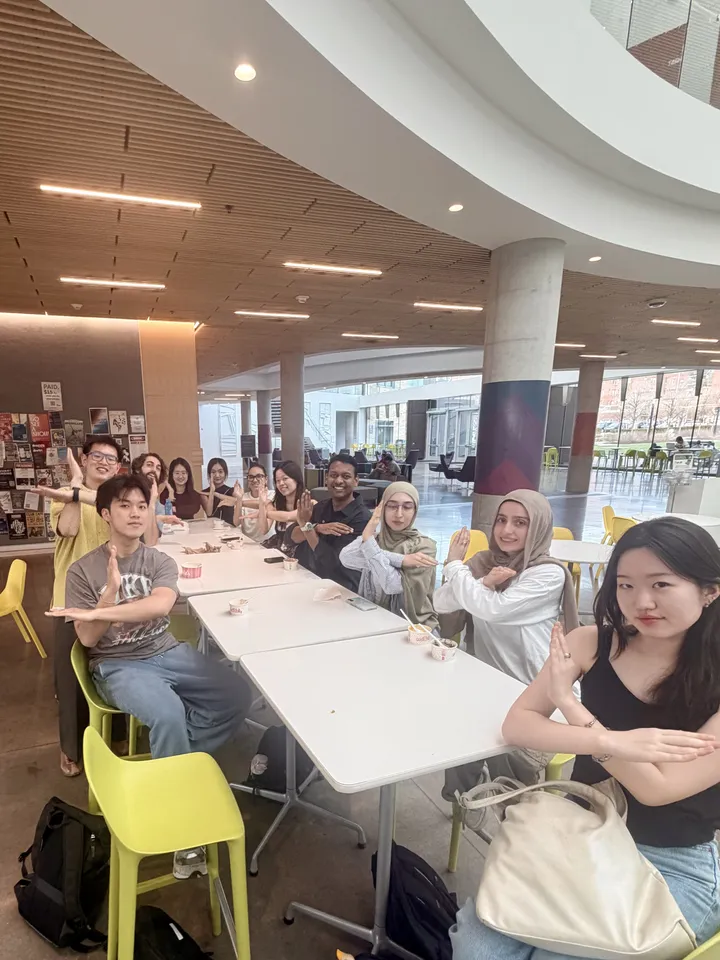
Bill Guo, second from left, with members of the PLUS student design team. Most contribute through one or two semesters of independent study before graduating, making continuity an essential design constraint. Courtesy of PLUS.
GeekPark: How do you maintain continuity when much of the design team is part-time and contributors rotate every semester? What have you learned that could help other organizations build stability with a fluid workforce?
Bill Guo: PLUS is a complex service, not a single interface. Designers need to understand middle-school students, college tutors, school partners, program operations, multiple product surfaces, our design system, and engineering constraints before their work is ready to build.
Before plus-uno, a new designer often needed four to six weeks to produce a first proposal an engineer could confidently work from. Much of that time went to archaeology: digging through old files, piecing together past decisions, and finding out why earlier directions were dropped. And every term, our most experienced designers graduated just as the next cohort started onboarding.
The hardest part was losing the reasoning. A designer might spend months learning why a workflow evolved, how a component should be used, which ideas we’d already tested, and where the engineering limits were. When they left, much of that left with them. The next designer inherited the files but had to rebuild the thinking.
So I started treating turnover as a design constraint, not a retention failure. Each designer still owns their project, and I still mentor, review, and sometimes work alongside them. But the context, decisions, standards, and review criteria have to be shared, and lessons have to be captured as the work happens. That gives the next person a real starting point without treating anyone as interchangeable.
I think that applies beyond PLUS. Teams that rely on contractors, fellows, or other part-time contributors need a way for each person’s work to improve what the next person inherits.
GeekPark: AI arrived in designers’ daily workflows at roughly the same time. Did it solve the continuity problem?
Bill Guo: It made individuals more capable, but it didn’t create continuity on its own. If anything, it made the gap more obvious.
A general-purpose model knows a lot, but it doesn’t know your organization—your users, product history, design system, or past decisions. So every new session starts with the same ritual: explain the product, attach the guidelines, point to the approved components, and remind the model what not to make up.
One designer may figure out an excellent way to make an AI agent follow the design system. Another may develop a strong accessibility-review prompt. But those breakthroughs often remain trapped in personal chats. Individuals become faster, while the organization itself does not become smarter.
Generating work gets cheaper, but without shared context and standards, reviewing and coordinating it gets more expensive.
What we were missing wasn’t a better model. It was infrastructure around the model—a way to turn scattered AI conversations into a practice the whole team builds on.
GeekPark: You call that infrastructure a “design harness.” Where does the term come from?
Bill Guo: I borrowed the word “harness” from agent engineering. The model provides general capability, while the harness provides the context, tools, memory, workflows, and feedback loops that make that capability reliable in a real environment.
The compact version is:
Agent = Model + Harness
What I did was translate that idea into something a design team can actually use and maintain.
For design, I think of the harness as five connected layers: context, skills, orchestration, evaluation, and knowledge compounding. In plain terms, it gives the agent the right background, reusable ways of working, an order to use them in, standards to check against, and a way to turn one project’s lessons into the next project’s starting point. Say a project keeps turning up the same design-system mistake: an agent can draft a rule for the team to review, and once it’s approved, the next designer and agent start with it.
As capable models become available to everyone, the lasting advantage is what surrounds them: an organization’s own knowledge, standards, and judgment.
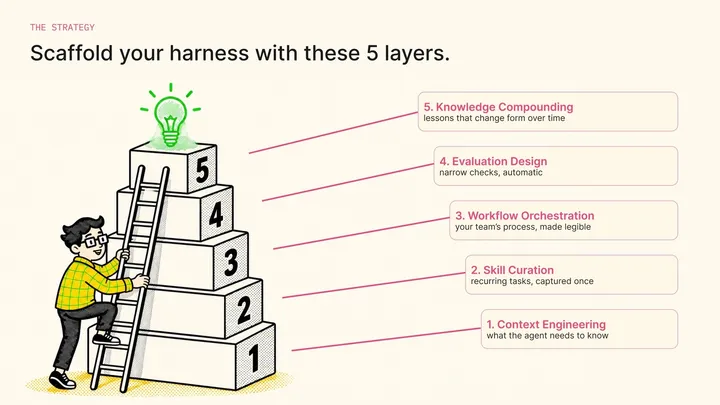
The design harness as five connected layers—context, skills, orchestration, evaluation, and knowledge compounding. Illustration by Boyuan Guo.
GeekPark: What have you actually built around this idea?
Bill Guo: The main implementation is plus-uno, an open-source design harness and workspace where I brought together product context, design components, reusable AI workflows, review criteria, and working prototypes.
It is not the production application. It is the environment that makes design work understandable to both people and AI agents.
Alongside it, uno-blueprint maps the tutoring experience together with the operations and technical systems behind it. We can pull out the part relevant to a school partner, a product discussion, or an engineering handoff and turn it into a deck, instead of rebuilding the story from scratch each time.
The harness also powers uno, the shared identity behind our agentic tools. In the IDE, uno helps with research, synthesis, prototyping, and review. In Slack, it shows up as uno-bot, answering questions grounded in our own sources and taking a limited set of approved actions. It also runs automated GitHub workflows.
The point is to make the team’s judgment available wherever people and AI are doing the work.
A walkthrough of plus-uno, the open-source design harness used by the PLUS design team. Source: github.com/BilLogic/plus-uno · plus-uno.netlify.app
GeekPark: Can you walk us through a scheduling case? What would a new designer do differently if a tutor called off a session and someone else needed to cover it?
Bill Guo: Here’s a recent one, from a session-coverage problem we mapped. When an assigned tutor can’t make a session, they submit a Call-Off, and another tutor can claim the open slot as a Fill-In. The tricky case was a Call-Off less than 24 hours out that nobody claims. A designer can’t quietly assume the session was canceled or reassigned; they need to take that question to the product and program teams.
Before plus-uno, finding the existing flow and the reasons behind it meant searching Slack, Figma, Notion, and other people’s memories. Now the designer can ask uno-bot in Slack, or uno in their IDE, to pull that history together: what the blueprint says about today’s Call-Off and Fill-In flows, whether earlier project cards proposed changes, and what recorded decisions say about coverage. It keeps those sources separate—current behavior from the blueprint, proposals from the cards—and flags gaps or conflicts instead of smoothing them over.
From there, the designer traces what the assigned tutor, a potential Fill-In tutor, the supervisor, and the schedule each do: how the open slot appears, who can claim it, how coverage gets confirmed, and what’s still undecided if nobody does. The agent brings in only the research, components, and design rules that matter, not the whole service blueprint. Then the designer builds a clickable prototype with the real component library and design tokens.
Before formal review, the harness catches the predictable problems: duplicated components, hard-coded values that should be tokens, and accessibility violations. That frees human reviewers to focus on whether the flow makes sense to tutors and how PLUS should handle the uncovered session.
If the project turns up a useful pattern or a recurring mistake, the designer can ask uno to draft a rule or decision for the shared repository, and a person reviews it before it’s merged. A one-off lesson stays as a project record; a recurring one can become a convention every future session loads automatically.
Since I introduced plus-uno, new designers typically reach a first proposal engineers can confidently build from within one week, down from four to six weeks. That doesn’t mean they understand all of PLUS or can work without guidance. It means they can produce something engineers understand and the design team can seriously critique.
What we removed was the archaeology, repeated explanation, and avoidable rework—not the thinking.
GeekPark: Looking beyond PLUS, how do you decide what to delegate to AI and what designers must retain?
Bill Guo: I hand AI the checks against standards we’ve already agreed on: approved components, accessibility requirements, and design-system consistency. Designers stay responsible for defining the problem and judging whether the result actually helps the user.
The harness can flag a duplicated button, a hard-coded color, or a contrast issue before human review. But a screen can pass every check and still solve the wrong problem, add unnecessary complexity, or confuse a first-time user. Recognizing that difference is still a designer’s call.
I am reluctant to draw a permanent boundary by task type. A task that requires a person today may be handled well by the next generation of models. What remains is human accountability for setting the standard and deciding when following it is not enough.
GeekPark: PLUS keeps a human tutor in the student relationship, while plus-uno is designed to work across AI models. What led to those choices? Would the harness also work for teams in mainland China using models such as Qwen or DeepSeek?
Bill Guo: AI tools can be strong at content support—explaining a concept, walking through a problem, giving practice. They are much weaker at the motivational help many students need. A model can mimic empathy, but students rarely feel as connected as they do with a real person—especially a tutor they can look up to and grow toward as a role model. Our research points to that motivational gap as the bigger bottleneck, which is why PLUS keeps a human tutor in the relationship. The tutor provides relationship and advocacy; AI sits behind the tutors to help with preparation, prioritization, and content support.
That choice isn’t only philosophical. Our team’s peer-reviewed quasi-experimental study covered 635 students in grades 5–8. In the most closely comparable sample, students who got human tutoring plus technology showed 61% greater relative growth on Measures of Academic Progress (MAP), a standardized math assessment, than students who used the software alone.
That’s the reason behind the tutoring product. The design-tool choice solves a different problem: we don’t want the team’s product knowledge and standards locked in one provider’s chat history. In plus-uno, that context, our workflows, and our accumulated decisions live in a shared workspace that different models can use. Whether a team uses Claude, Qwen, DeepSeek, or another provider, the missing half is the same: durable context and standards that travel with the work.
So a team can use whichever models it has access to, and switch later, without rebuilding its design practice from scratch.
The same idea matters when a model upgrade arrives. We try not to treat prompts—or any one model—as the thing the team depends on. The product context, standards, and decisions we have documented live in a shared workspace with a history of changes, so the model is the part we can swap—not the core of the system.
For uno-bot, we also re-run a small set of fixed test conversations after each model change to catch when behavior drifts. An upgrade may still require a small adjustment, but it should not erase what the team has already learned.
That is also why I made plus-uno public and later released the harness-designing plugin.
The goal is not for another team to copy PLUS’s internal rules. It is to give them a structure they can adapt to their own context, workflows, judgment, and choice of tools.
GeekPark: For a startup moving quickly, does adding a harness create more process—or help the team build a better product faster?
Bill Guo: A bad harness can absolutely become another documentation burden. A useful one should replace work the team is already repeating: re-explaining the product, searching for past decisions, correcting the same design-system violations, and rebuilding handoff context.
A startup doesn’t need an elaborate platform. I’d start with the questions the team keeps answering, turn two or three proven methods into reusable workflows, and add checks for the mistakes reviewers keep catching.
If maintaining the harness becomes a separate ceremony, it will decay. It has to improve through the work itself.
The payoff goes beyond faster onboarding. When the system catches duplicated components, accessibility issues, and inconsistent patterns before formal review, designers get more time for user research, iteration, and the hard product decisions that need judgment. Shared context also keeps decisions coherent across the product, instead of optimizing one screen at a time.
A better model can help a team produce more, but it still needs to know which patterns the team uses, which approaches it rejected, and why.
Cheaper generation means more work happening in parallel. The leadership challenge is keeping all of it pointed at the same customer experience. A good harness lets a fast-moving team produce more without inconsistency and cleanup growing just as fast.
GeekPark: How has this changed the way you think about the designer’s role?
Bill Guo: We will still make interfaces and experiences, but our role increasingly includes shaping the conditions under which humans and AI create them together.
I still design hands-on, but more of my work now goes into maintaining the context, workflows, and review standards that help other people produce good work.
That shift expands design operations beyond schedules, files, and coordination. It means expressing judgment as infrastructure: deciding what evidence an agent should retrieve, what it should check before asking for human attention, and how one project should make the next project better.
In practice, it changes what I treat as the unit of design. I’m not only asking whether a screen works, but whether the research, rationale, components, and review criteria behind it will still be usable by the next designer or agent. I stay hands-on where things are ambiguous or high-stakes, and try to turn repeatable judgment into shared context and checks. A project feels finished when it also improves the system that shapes the next one.
That’s part of why it meant a lot when PLUS was named one of three finalists for the 2026 UXDX Unblocker Award. It recognized design work that’s easy to miss: holding on to knowledge in a rotating team, cutting rework for engineers, and letting product managers handle small changes that used to need a designer.
Good decisions should be reusable. When a designer leaves, the next person should inherit more than files: they should be able to see the research, reasoning, and standards behind the work.